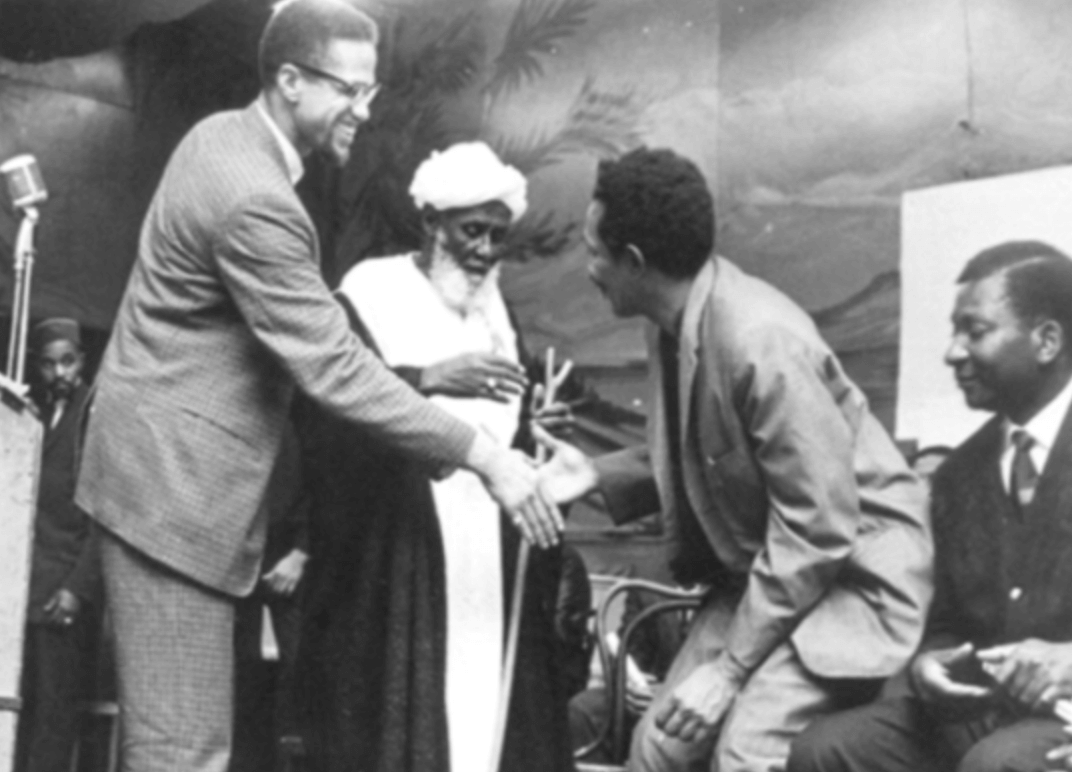
Malcolm X, Shaykh Aḥmad Ḥassūn, and the Black Saudi Connection
Aḥmad Usmān, who meticulously planned the ḥajj of Malcolm X (1925–1965 CE), emphasised the role played by the Black Saudis whom Malcolm encountered during his pilgrimage. Among them, he highlighted Muḥammad Surūr Ṣabbān (1898–1978 CE), a poet, politician, and Saudi Arabia’s second Minister of Finance. Ṣabbān, a Saudi of African descent, took Malcolm under his wing and appointed the Sudanese Shaykh Aḥmad Ḥassūn as his Islamic adviser.
Following this period, Malcolm X expressed interest in establishing branches of the Muslim World League in Harlem, New York. It was reported that Shaykh Aḥmad Ḥassūn would visit Harlem and reside at the Theresa Hotel, where Malcolm was then based.
Shaykh Aḥmad Ḥassūn and Anṣār as-Sunnah al-Muḥammadiyyah in Sudan
Shaykh Aḥmad Ḥassūn (1897–1971 CE) is widely regarded as the founding leader of Anṣār as-Sunnah al-Muḥammadiyyah in Sudan. This refers to the original religious movement, praised by major scholars such as Muḥammad Ḥāmid al-Fiqī (1892–1959 CE), ʿAbd al-ʿAzīz ibn Bāz (1330–1420 AH/1910–1999 CE), Muḥammad Nāṣir ad-Dīn al-Albānī (1333–1420 AH/1914–1999 CE), and Muḥammad al-Bannā (1907–1998 CE), and not the later political party bearing a similar name.
Shaykh Aḥmad Ḥassūn occupied a unique position within Sudanese society. Having graduated from the Postal and Telegraph School, he was considered an Effendi, yet he never lost sight of his responsibilities to religion and society. He devoted his life to Islamic sciences, spreading the sunnah while opposing religious innovations (bidʿah) and the established Ṣūfī paths. Because of his firm stance against political parties, movements, and innovations, he suffered opposition from multiple quarters.
He was among the earliest figures to raise the banner of tawḥīd and sunnah in Sudan during a critical period marked by increasing sectarianism. Despite persecution, hardship, and social pressure, he remained steadfast in his mission.
Shaykh Aḥmad Ḥassūn held that an individual must know Islam as it was originally revealed in the Qurʾān and the sunnah, and that true happiness and progress cannot be attained without correct religious knowledge. Through Anṣār as-Sunnah al-Muḥammadiyyah, he worked extensively across regions of Sudan where sectarianism was entrenched, often facing violence and armed conflict.
Despite these trials, he was known for his sharp wit, strong debating skills, and warm sense of humour. He was well-versed in both Arabic and English literature and frequently delivered lectures in both languages. Prior to Sudan’s independence (1956 CE), his work in the postal service enabled him to communicate and collaborate with Salafī scholars and movements across the Muslim world.
Malcolm X, Shaykh Ḥassūn, and the Harlem Years
When Malcolm X visited the Holy Lands, he stayed with Shaykh Aḥmad Ḥassūn in Makkah. King Fayṣal ibn ʿAbd al-ʿAzīz Āl Saʿūd (1906–1975 CE) later appointed Shaykh Aḥmad as a guide for Malcolm and as a teacher at the newly established Islamic Mosque No. 7 in Harlem, New York.
Malcolm X delivered lectures at the mosque and oversaw the African-American Union, which he established following his return from ḥajj. Alongside this work, Shaykh Ḥassūn served as his religious mentor, guiding him through the foundational concepts of Islam and the meanings of Islamic texts. He assisted Malcolm in understanding Islamic fundamentals as he educated the African-American community.
During Malcolm’s public lectures and religious seminars, Shaykh Aḥmad Ḥassūn was frequently seen at his side. He continued to accompany Malcolm, advise him, explain Qurʾānic verses and legal rulings, and provide religious guidance until Malcolm X’s assassination in 1965 CE.
Shaykh Ḥassūn at Malcolm X’s Funeral
Alex Haley and Malcolm X give the following account in The Autobiography of Malcolm X:
“In the Unity Funeral Home in the Harlem community of New York City in the mid-afternoon, the public’s viewing of the body of Malcolm X was interrupted by the arrival of a party of about a dozen people whose central figure was a white-turbaned, dark-robed elderly man whose white beard fell to his chest and who carried a forked stick. When reporters rushed to attempt interviews, another man in the party waved them away, saying, ‘A silent tongue does not betray its owner.’ The man was Shaykh Aḥmad Ḥassūn, a Sudanese, a member of the Sunni Moslems, who had taught in Mecca for 35 years when he had met Malcolm X there, and then had soon come to the United States to serve as Malcolm X’s spiritual advisor and to teach at the Muslim Mosque, Inc.
Shaykh Ḥassūn prepared the body for burial in accordance with Moslem ritual. Removing the Western clothing in which the body had been on display, Shaykh Ḥassūn washed the body with special holy oil. Then he draped the body in the traditional seven white linen shrouds, called the kafan. Only the face with its reddish moustache and goatee was left exposed. The mourners who had come with Shaykh Ḥassūn filed to the bier and he read passages from the Koran. Then he turned to a funeral home representative: ‘Now the body is ready for burial.’ Soon, the sheik and his retinue left, and the viewing by the public resumed. When the word spread, numbers of persons who had come before returned for another wait in the long, slowly moving line, wanting to see the Moslem burial dress.” [The Autobiography of Malcolm X.]
References
Haley, Alex, and Malcolm X, The Autobiography of Malcolm X.