Ṣalaḥ al-Irānī
March 4, 2017
5 mins read

﷽
The author, Imām Abū Muḥammad al-Ḥasan ibn ʿAlī ibn Khalaf al-Barbahārī (d. 329 AH / 941 CE), may Allah have mercy upon him, said:
“Know, may Allah have mercy upon you, that knowledge is not simply narrating a great deal or possessing many books. Rather, the scholar is the one who follows the knowledge he has acquired and the Sunnah, even if his knowledge is small and he only possesses a few books. Whoever contradicts the Book and the Sunnah is an innovator, even if he is very knowledgeable and has many books.”
Explanation of Shaykh Ṣāliḥ ibn Fawzān al-Fawzān
Knowledge is not merely the accumulation of information, extensive reading, or the possession of numerous books. Rather, true knowledge is accompanied by understanding, adherence, and action upon what has been learnt, even if a person’s knowledge is limited. A small amount of knowledge combined with righteous deeds and sound understanding of the religion is of great value, whereas abundant knowledge without action or adherence brings no real benefit.
Among the Jews were scholars and rabbis who possessed knowledge, yet it did not benefit them. They became among those upon whom the anger of Allah is incurred because they disobeyed Allah ﷻ knowingly and with insight.
The objective, therefore, is not to amass information or become widely read, but to act. This is the true meaning of knowledge and the path of those upon whom Allah ﷻ has bestowed His favour. Allah, the Most High, says:
۞ صِرَاطَ الَّذِينَ أَنْعَمْتَ عَلَيْهِمْ ۞
“Guide us to the Straight Way. The Way of those on whom You have bestowed Your Favour.” ۞ [al-Fātiḥah 1:7]
These are the people of knowledge and action.
Allah also says:
۞ غَيْرِ الْمَغْضُوبِ عَلَيْهِمْ ۞
“Not (the way) of those who earned Your Anger (such as the Jews).” ۞
These are the people who possessed knowledge but did not act upon it.
۞ وَلَا الضَّالِّينَ ۞
“Nor of those who went astray (such as the Christians).” ۞
These are those who acted without knowledge.
Knowledge does not benefit unless it is accompanied by action, and action does not benefit unless it is accompanied by knowledge. Both must be combined. This is the way of those upon whom Allah’s favour has been bestowed. His statement, “Rather, the scholar is the one who follows the Book and the Sunnah, even if his knowledge is small and he only possesses a few books,” establishes that true scholarship lies in adherence to the Qurʾān and the Sunnah, regardless of the quantity of knowledge one has acquired. In contrast, a person may possess vast learning and many books, yet if he does not act upon them, his knowledge is of no benefit.
When knowledge is accompanied by righteous action, it increases, grows, and becomes blessed. When it is not accompanied by action, its blessing is removed and it diminishes.
The scholars are of two categories:
Those who possess knowledge of the tongue only.
Those who possess knowledge of the tongue and heart, and they are the ones who fear Allah ﷻ.
Allah, the Most High, says:
۞ إِنَّمَا يَخْشَى اللَّهَ مِنْ عِبَادِهِ الْعُلَمَاءُ ۗ ۞
“It is only those who have knowledge among His slaves that fear Allah.” ۞ [al-Fāṭir 35:28]
Correct knowledge is that which produces fear of Allah ﷻ. As for knowledge of the tongue without fear of Allah, it resembles the knowledge of the hypocrites. We ask Allah ﷻ for safety and protection. His statement, “Whoever contradicts the Book and the Sunnah is an innovator,” clarifies the definition of innovation (bidʿah). Innovation refers to acts of worship introduced in order to draw closer to Allah without any proof from the Qurʾān or the Sunnah.
The Prophet ﷺ said: “Whoever introduces into this affair of ours that which is not from it will have it rejected.” (al-Bukhārī, no. 2697). In another narration, he ﷺ said: “Whoever performs an action that is not in accordance with our affair will have it rejected.” (Muslim, no. 1718)
This means that such actions are rejected and not accepted by Allah, because they have not been legislated by Allah or His Messenger ﷺ. The scholars have mentioned that actions are not accepted except when two conditions are fulfilled: Firstly, that the action is performed sincerely for Allah ﷻ and is free from shirk. Secondly, that it conforms to the Sunnah of the Messenger ﷺ by abandoning innovations and newly invented matters.
Every action mixed with shirk is invalid, and every action based upon innovation is invalid. Actions are only correct and accepted when they are performed solely for the sake of Allah ﷻ and in accordance with the Sunnah of the Messenger of Allah ﷺ. His statement, “even if he is very knowledgeable and has many books,” indicates that an innovator does not benefit from his knowledge, even if it were as vast as the sea. If he does not follow the Messenger ﷺ, and instead follows the opinions of individuals without evidence, his knowledge and books bring him no benefit.
Allah ﷻ says regarding the Jews:
۞ مَثَلُ الَّذِينَ حُمِّلُوا التَّوْرَاةَ ثُمَّ لَمْ يَحْمِلُوهَا كَمَثَلِ الْحِمَارِ يَحْمِلُ أَسْفَارًا ۚ بِئْسَ مَثَلُ الْقَوْمِ الَّذِينَ كَذَّبُوا بِآيَاتِ اللَّهِ ۚ وَاللَّهُ لَا يَهْدِي الْقَوْمَ الظَّالِمِينَ ۞
“The likeness of those who were entrusted with the Taurāt (Torah) but failed to carry out its obligations is like the likeness of a donkey carrying books. How evil is the example of the people who deny the Signs of Allah.” ۞ [al-Jumuʿah 62:5]
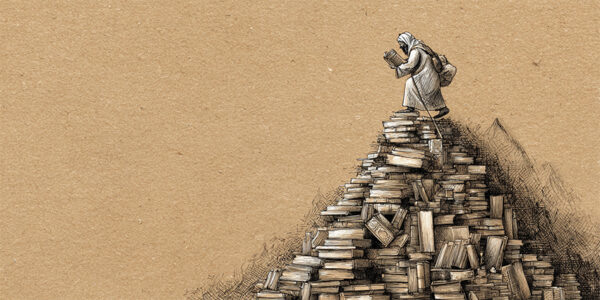
Thus, the one who possesses a vast library yet abandons acting upon his knowledge, or engages in innovation, resembles a donkey carrying books without benefiting from them.
Reference
Ṣāliḥ ibn Fawzān al-Fawzān (b. 1354 AH / 1933 CE), Ithāf al-Qārī fī Sharḥ al-Sunnah li-al-Barbahārī, 2 vols, Maktabat al-Rushd, Riyadh, 2003, vol. 2, p. 49, no. 104.
June 2, 2026
6 mins read