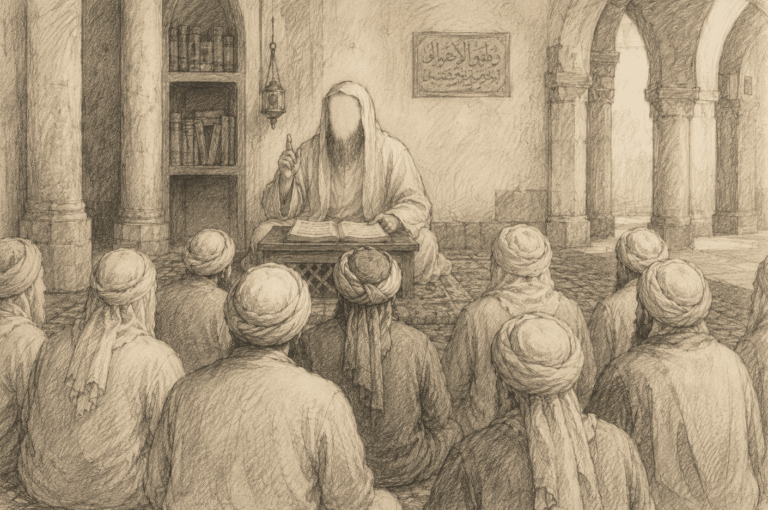
Teaching and studying depend greatly on the audience, the teacher, the level of the students and the nature of the sitting. It used to be said that one year in Dammāj could be like five years elsewhere, because of the intensity and consistency of study. Likewise, we have seen Shaykh Ibn Bāz complete the teaching of al-Uṣūl ath-Thalāthah in just under two hours, while other scholars have spent months, and sometimes far longer, teaching comparable works.
So how long should it take a student of knowledge to complete a book?
The question appears simple, but the scholarly tradition suggests that duration alone is a poor measure of the depth or quality of study. Major works were sometimes completed by eminent scholars in a single sitting or over several days, while other works were taught across hundreds of sittings. The same text could even be approached at different speeds by the same scholar on different occasions.
The more useful question, therefore, is not merely how quickly a book was completed, but what kind of engagement with the book actually took place.
Was the text simply recited? Was it surveyed to understand its contents and organisation? Was it accompanied by a concise explanation? Was every expression analysed in detail? Were subsidiary questions and scholarly disagreements investigated? Was the material memorised, revised and revisited? And, perhaps most importantly, what level of knowledge was the completion subsequently understood to represent?
These distinctions are essential, because completing a book, studying a book and mastering a book are not necessarily the same thing.
What follows sets out the distinctions found within the scholarly tradition itself and uses them to answer a more precise question: what does the speed of completing a book actually tell us about the quality of its study?
The Stages of Acquiring Knowledge
Ibn al-Qayyim al-Jawziyyah (d. 751 AH/1350 CE) enumerates the stages by which knowledge is acquired. He states:
وَلِلْعِلْمِ سِتُّ مَرَاتِبَ: أَوَّلُهَا: حُسْنُ السُّؤَالِ. الثَّانِيَةُ: حُسْنُ الْإِنْصَاتِ وَالِاسْتِمَاعِ. الثَّالِثَةُ: حُسْنُ الْفَهْمِ. الرَّابِعَةُ: الْحِفْظُ. الْخَامِسَةُ: التَّعْلِيمُ. السَّادِسَةُ، وَهِيَ ثَمَرَتُهُ: الْعَمَلُ بِهِ وَمُرَاعَاةُ حُدُودِهِ
“Knowledge has six stages: the first is asking questions in a good manner; the second, listening attentively and in silence; the third, understanding well; the fourth, memorisation; the fifth, teaching; and the sixth, which is its fruit, is acting upon it and observing its limits.” (Ibn al-Qayyim al-Jawziyyah, Miftāḥ Dār as-Saʿādah wa Manshūr Wilāyat Ahl al-ʿIlm wa-l-Irādah, p. 283)
The enumeration indicates that encountering a text is a single component within a longer sequence, and that the sequence does not terminate at completion. A student may hear an entire book without retaining it, understand its general argument without commanding its details, memorise portions while remaining unable to teach them, and know a ruling without having yet incorporated it into practice.
Completion of a book and mastery of a book are therefore two distinct accomplishments. Much of what follows is an elaboration of this distinction.
It is worth noting that the enumeration is frequently reproduced as five stages, beginning with attentive listening. Ibn al-Qayyim in fact begins with ḥusn as-suʾāl, asking well, which is the student’s own active contribution to the process.
Different Forms of Reading
One of the clearest treatments of this subject is found in the classification of the methods used for reading works of ḥadīth. Ṣiddīq Ḥasan Khān (d. 1307 AH/1890 CE) describes three distinct modes (al-Ḥiṭṭah fī Dhikr aṣ-Ṣiḥāḥ as-Sittah, vol. 1, p. 131).
- As-Sard. The reader or teacher proceeds rapidly and continuously through the text of a collection together with its chains of transmission, without halting for detailed linguistic explanation, juristic debate or investigation into the biographies of narrators. Its purpose is principally the reading and transmission of the text.
- Ṭarīq al-Ḥall wa-l-Baḥth. An intermediate method. A ḥadīth is recited and the teacher pauses briefly to clarify matters such as uncommon vocabulary, difficult constructions, rare names appearing in the chain, and prominent legal or scholarly points, before proceeding to the next narration.
- Ṭarīq al-Imʿān. The exhaustive method, directed at comprehension. Individual words are analysed linguistically, their roots investigated, and parallels from Arabic usage or poetry adduced. Narrators are discussed in detail, including lineages, biographies and tribal affiliations. Juristic deductions, subsidiary questions, contextual reports and scholarly disagreements are all examined.
Shaykh Muḥammad ibn Ṣāliḥ al-ʿUthaymīn (d. 1421 AH/2001 CE) draws a parallel distinction outside the ḥadīth sciences, between contemplative reading, which by its nature requires deliberation, and rapid survey reading undertaken in order to discover a book’s contents, arrangement and general benefit (Majmūʿ Fatāwā wa Rasāʾil ash-Shaykh Muḥammad ibn Ṣāliḥ al-ʿUthaymīn, vol. 26, p. 336).
The consequence is that the bare statement “we studied this book” is too ambiguous to evaluate without knowing which mode was intended. A work completed by sard in three sittings and the same work studied by imʿān over three years are both genuine and complete encounters with the text, and they are not the same activity. There is accordingly no single scholarly speed at which every book must be read; the appropriate pace depends substantially upon the purpose of the reading.
Rapid Completion in the Scholarly Record
The historical accounts provide striking examples of scholars completing substantial works within very short periods, and the reports are numerous enough that no account of traditional pedagogy can treat rapid completion as an aberration.
- Al-Khaṭīb al-Baghdādī read Ṣaḥīḥ al-Bukhārī in three sittings (al-Khaṭīb, Tārīkh Baghdād, 6/314; adh-Dhahabī comments on it in Siyar Aʿlām an-Nubalāʾ, 18/279–280, and in Tārīkh al-Islām, deaths of 463 AH, p. 99).
- He also read Ṣaḥīḥ al-Bukhārī in five days with Karīmah al-Marwaziyyah (adh-Dhahabī, Tadhkirat al-Ḥuffāẓ, 3/1138; also Tārīkh al-Islām, deaths of 463 AH, p. 92; aṣ-Ṣafadī, al-Wāfī bi-l-Wafayāt, 7/192).
- ʿAbdullāh ibn Labbāj read Ṣaḥīḥ Muslim in about one week (Ibn Bashkuwāl, aṣ-Ṣilah, 1/265). Al-Muʾtaman as-Sājī read al-Muḥaddith al-Fāṣil in one sitting (adh-Dhahabī, Siyar Aʿlām an-Nubalāʾ, 19/310).
- Ṭalḥah ibn Muẓaffar al-ʿAlthī read Ṣaḥīḥ Muslim in three sittings (Ibn Rajab, adh-Dhayl ʿalā Ṭabaqāt al-Ḥanābilah, 1/390; also Ṭabaqāt al-Mufassirīn, 1/266). Al-ʿIzz ibn ʿAbd as-Salām completed Nihāyat al-Maṭlab in roughly three days of intensive reading (Ibn Fahd, Laḥẓ al-Alḥāẓ, p. 201).
- Ibn al-Abbār read Ṣaḥīḥ Muslim in six days (adh-Dhahabī, Siyar Aʿlām an-Nubalāʾ, 21/253).
- Ibn Taymiyyah (d. 728 AH/1328 CE) read al-Ghaylāniyyāt in one sitting (Ibn ʿAbd al-Hādī, Mukhtaṣar Ṭabaqāt ʿUlamāʾ al-Ḥadīth, 4/281–282).
- Al-Mizzī read aṭ-Ṭabarānī’s al-Muʿjam al-Kabīr in sixty sittings (Muʿjam Samāʿāt al-Barzālī, fol. 232a).
- Adh-Dhahabī read the Sīrah of Ibn Hishām in six days (adh-Dhahabī, Tārīkh al-Islām, cited through Bashshār ʿAwwād’s study, p. 94).
- Zayn ad-Dīn al-ʿIrāqī read Ṣaḥīḥ Muslim in six consecutive sittings (al-Fāsī, Dhayl at-Taqyīd, 3/9; Ibn Fahd, Laḥẓ al-Alḥāẓ, p. 223), and Musnad Aḥmad in thirty sittings (al-Fāsī, Dhayl at-Taqyīd, 3/9).
- Al-Fīrūzābādī read Ṣaḥīḥ Muslim in three days (as-Sakhāwī, aḍ-Ḍawʾ al-Lāmiʿ, 10/80; al-Jawāhir wa-d-Durar, 1/103–104; al-Maqqarī, Azhār ar-Riyāḍ, 3/48).
Ibn Ḥajar al-ʿAsqalānī (d. 852 AH/1449 CE) left behind an especially rich record of such readings.
He read Musnad Aḥmad with its additions in fifty-three sittings (Ibn Ḥajar, al-Majmaʿ al-Muʾassis, 2/27, 32; Inbāʾ al-Ghumr, 5/241);
Ṣaḥīḥ al-Bukhārī in ten sittings of four hours each (as-Sakhāwī, al-Jawāhir wa-d-Durar, 1/104);
Ṣaḥīḥ Muslim in five sittings (Ibn Ḥajar, al-Majmaʿ al-Muʾassis, 2/478; Inbāʾ al-Ghumr, 7/342; as-Sakhāwī, al-Jawāhir wa-d-Durar, 1/103);
an-Nasāʾī’s as-Sunan al-Kubrā in ten sittings of about four hours (as-Sakhāwī, al-Jawāhir wa-d-Durar, 1/104); S
unan Ibn Mājah in four sittings (as-Sakhāwī, al-Jawāhir wa-d-Durar, 1/103); a
nd al-Muʿjam aṣ-Ṣaghīr in one sitting between Ẓuhr and ʿAṣr (Ibn Ḥajar, al-Majmaʿ al-Muʾassis, 2/324; al-Fāsī, Dhayl at-Taqyīd, 2/119; Ibn Fahd, Laḥẓ al-Alḥāẓ, p. 336; as-Sakhāwī, al-Jawāhir wa-d-Durar, 1/104).
- Ad-Dīmī read Ṣaḥīḥ al-Bukhārī in four days (as-Sakhāwī, aḍ-Ḍawʾ al-Lāmiʿ, 5/141).
- Al-Qasṭallānī read Ṣaḥīḥ al-Bukhārī in five sittings (as-Sakhāwī, aḍ-Ḍawʾ al-Lāmiʿ, 2/103; ash-Shawkānī, al-Badr aṭ-Ṭāliʿ, 1/102).
- Ibrāhīm al-Biqāʿī read Ṣaḥīḥ al-Bukhārī in six days and Ṣaḥīḥ Muslim in five days, spread over twenty days (an-Najm al-Ghazzī, al-Kawākib as-Sāʾirah, 2/76; Ibn al-ʿImād, Shadharāt adh-Dhahab, 8/205–206).
When as-Sakhāwī asked Ibn Ḥajar whether he had ever read for an entire day as al-Khaṭīb had, Ibn Ḥajar replied that he had not, and then remarked:
وَلَكِنْ أَيْنَ الثُّرَيَّا مِنَ الثَّرَى؛ فَإِنَّ الْخَطِيبَ قِرَاءَتُهُ فِي غَايَةٍ مِنَ الصِّحَّةِ وَالْجَوْدَةِ وَالْإِفَادَةِ وَإِبْلَاغِ السَّامِعِينَ
“Yet where are the stars compared with the earth? Al-Khaṭīb’s reading, may Allah have mercy upon him, was at the utmost level of accuracy, quality, benefit, and making the listeners hear clearly.” (As-Sakhāwī, al-Jawāhir wa-d-Durar, 1/104)
The practice was not confined to ḥadīth. Al-Qāḍī ʿIyāḍ (d. 544 AH/1149 CE) records reading the Risālah of Ibn Abī Zayd al-Qayrawānī to Abū al-Qāsim Ibn an-Naḥḥās in a single sitting at his home in Córdoba (ʿAbd al-Ḥayy al-Kattānī, Fihris al-Fahāris wa-l-Athbāt, vol. 2, p. 1048, citing al-Qāḍī ʿIyāḍ, al-Ghunyah).
Ibn al-Jazarī (d. 833 AH/1429 CE) states that he read Kitāb al-ʿUnwān, a work concerning the seven canonical readings, to ʿAbd al-Ghaffār as-Saʿdī in one sitting while a group listened to his recitation (Ghāyat an-Nihāyah fī Ṭabaqāt al-Qurrāʾ, vol. 2, p. 596).
That final qualification is instructive. A rapid completion need not represent the student’s first encounter with the material. What appears to an observer as several hours of study may in fact stand at the terminus of years of memorisation, prior reading and preparation.
Transmission, Understanding and Mastery
The historical examples become clearer when three concepts are held apart. Riwāyah is the receiving, reading and transmitting of a text. Dirāyah is the understanding of its meanings, implications and scholarly discussions. Malakah is the settled scholarly faculty by which the material is recalled, analysed and applied.
These do not necessarily proceed at the same rate. A scholar may transmit an entire collection across several sittings while spending years developing the disciplines required to understand its narrations.
This explains why extraordinarily rapid readings should be neither dismissed nor exaggerated. A rapid reading establishes that the text was rapidly read. It does not, of itself, establish that every linguistic, doctrinal, juristic or ḥadīth-related question within it was exhaustively examined during those sittings. Equally, the speed of the reading does not render it academically meaningless; it may fulfil a legitimate scholarly purpose appropriate to that particular sitting, whether audition, transmission, revision, memorisation or survey.
It also bears observing what the reports describe. Ibn Ḥajar did not approach al-Muʿjam aṣ-Ṣaghīr as a beginner encountering unfamiliar material, but as a ḥāfiẓ for whom the chains and texts were already largely known, and for whom the sitting served the purpose of samāʿ, formal audition, rather than instruction. The reports document what accomplished scholars could do with texts they had already assimilated.
Alongside these accounts, the tradition also preserves a marked emphasis on gradual acquisition. It is reported that Ibn Shihāb az-Zuhrī (d. 124 AH/742 CE) said to Yūnus ibn Yazīd:
يَا يُونُسُ، لَا تُكَابِرِ الْعِلْمَ؛ فَإِنَّ الْعِلْمَ أَوْدِيَةٌ، فَأَيُّهَا أَخَذْتَ فِيهِ قَطَعَ بِكَ قَبْلَ أَنْ تَبْلُغَهُ، وَلَكِنْ خُذْهُ مَعَ الْأَيَّامِ وَاللَّيَالِي، وَلَا تَأْخُذِ الْعِلْمَ جُمْلَةً؛ فَإِنَّ مَنْ رَامَ أَخْذَهُ جُمْلَةً ذَهَبَ عَنْهُ جُمْلَةً، وَلَكِنِ الشَّيْءُ بَعْدَ الشَّيْءِ مَعَ اللَّيَالِي وَالْأَيَّامِ
“O Yūnus! Do not try to overcome knowledge, for verily knowledge is like vast valleys: whichever of them you take will stop you before you traverse it. Instead, take it over the days and nights. And do not take knowledge all at once, for whoever tries to take it all at once will lose it all at once. Rather, take it bit by bit, over the days and nights.” (Ibn ʿAbd al-Barr, Jāmiʿ Bayān al-ʿIlm wa Faḍlih, vol. 1, p. 431, no. 652; and al-Khaṭīb al-Baghdādī, al-Faqīh wa-l-Mutafaqqih)
And Yaḥyā ibn Abī Kathīr (d. 129 AH/747 CE) said:
لَا يُسْتَطَاعُ الْعِلْمُ بِرَاحَةِ الْجِسْمِ
“Knowledge is not attained with a comfortable body.” (Ṣaḥīḥ Muslim, Kitāb al-Masājid, vol. 1, p. 428)
These statements do not prohibit a rapid reading. They locate where knowledge settles, which is a separate matter from where a text is first encountered.
Repetition: The Same Book, More Than Once
The two bodies of evidence are reconciled by the principle of tadarruj, stated with unusual clarity by Ibn Khaldūn (d. 808 AH/1406 CE), who held that effective instruction requires passing over a discipline three separate times (al-Muqaddimah, in the chapter on the correct manner of teaching the sciences and the method of imparting them).
In the first pass, the teacher presents the principal questions of the discipline in summary form, attending to the student’s capacity and preparedness, and confining himself to general principles. In the second, he raises the level, moving beyond summary to fuller exposition and mentioning points of disagreement. In the third, he returns to the discipline once the student is seasoned, leaving nothing obscure or closed, and completing his mastery of it.
Ibn Khaldūn is explicit that difficulty arises when this order is inverted and the exhaustive treatment is presented at the outset, so that the beginner is asked to resolve problems he has no equipment to resolve, and comes to believe the difficulty lies in the discipline itself.
On this account, a rapid first completion and a deep study of the same work are not competing approaches but consecutive stages of a single method. A student may first read a concise commentary to acquire the structure of the subject, then memorise the matn, then return to an expansive explanation, then annotate, revise, teach portions, compare further commentaries, and continue returning to the text across many years. The rapid first reading may actively facilitate the later detailed study, because the student comes to it already possessing a mental map of the work.
What this framework does not accommodate is treating the first completion as the terminus of the educational process rather than its opening stage.
Ḥadīth, the Qurʾān and Creed
The evidence should not be flattened into a single undifferentiated rule about “reading books”. These disciplines are not read for identical purposes, and the legitimate pace of engaging with each differs accordingly.
Ḥadīth. Rapid reading is most firmly attested here, precisely because a reading of the sard type serves riwāyah: the transmission and audition of a text with its chain, not the exhaustive derivation of every ruling it contains. A scholar could therefore read hundreds or thousands of narrations rapidly without claiming that every legal deduction, linguistic issue and biographical question within them had been investigated during that sitting. The distinction between riwāyah and dirāyah is decisive.
The Qurʾān. The Qurʾān presents a further dimension. Allah, the Most High, says:
﴿إِنَّا سَنُلْقِي عَلَيْكَ قَوْلًا ثَقِيلًا﴾
“Verily, We shall send down to you a weighty Word.” [Q 73:5]
And He says:
﴿وَقُرْآنًا فَرَقْنَاهُ لِتَقْرَأَهُ عَلَى النَّاسِ عَلَىٰ مُكْثٍ وَنَزَّلْنَاهُ تَنزِيلًا﴾
“And (it is) a Qurʾān which We have divided (into parts), in order that you might recite it to men at intervals. And We have revealed it by stages.” [Q 17:106]
Abū ʿAbd ar-Raḥmān as-Sulamī (d. 74 AH/693 CE) reported from the Companions who taught him the Qurʾān, among them ʿUthmān ibn ʿAffān and ʿAbdullāh ibn Masʿūd , that they would learn ten verses from the Prophet and would not proceed to the next ten until they had learned the knowledge and the action contained within them. They would say:
فَتَعَلَّمْنَا الْقُرْآنَ وَالْعِلْمَ وَالْعَمَلَ جَمِيعًا
“So we learned the Qurʾān, the knowledge, and the action together.” (Reported by Aḥmad in his Musnad; by aṭ-Ṭabarī in the introduction to his Jāmiʿ al-Bayān; and cited by as-Suyūṭī, al-Itqān fī ʿUlūm al-Qurʾān, vol. 2, p. 176)
This establishes a pedagogical model in which understanding and practice accompany acquisition. It does not render rapid recitation illegitimate, and rapid completions of the Qurʾān are also reported from the early generations. Rather, the distinction concerns what is being described. Completing a recitation quickly is not the same accomplishment as completing a study of the Qurʾān’s meanings, rulings, tafsīr and application. Both are legitimate, and they are different.
Creed. Works of ʿaqīdah sit between these poles. A concise matn may be recited rapidly, explained briefly, memorised or studied exhaustively, and the appropriate pace is determined less by the label of the discipline than by the purpose of the sitting and the level of explanation intended. A short introductory explanation may be entirely appropriate for beginning students, and the same text may later be revisited with a longer commentary in which its evidences, terminology, objections and subsidiary questions are treated at considerably greater depth.
Because doctrinal propositions are densely interrelated and carry major practical consequences, the distinction between a brief reading and an expansive one is particularly worth preserving here, and later revision and deeper study remain necessary in a way that an audition aimed only at transmission does not require.
Kitāb at-Tawḥīd as a Case Study
Shaykh Muḥammad ibn ʿAbd al-Wahhāb (d. 1206 AH/1792 CE) constructed Kitāb at-Tawḥīd around chapter headings followed by Qurʾānic verses, Prophetic narrations and reports, with concluding doctrinal masāʾil. The arrangement is deliberate: the scriptural evidence explains the chapter heading, and the concluding issues express the understanding derived from that evidence (at-Tamhīd li-Sharḥ Kitāb at-Tawḥīd, vol. 1; Ṣāliḥ ibn Fawzān al-Fawzān, Iʿānat al-Mustafīd bi-Sharḥ Kitāb at-Tawḥīd, vol. 1, p. 11).
That structure permits instruction at markedly different depths. A teacher might read the chapter heading and evidences with minimal comment; give a concise explanation of the central meaning of each chapter; explain unfamiliar vocabulary and the principal doctrinal questions; discuss every evidence and its relationship to the heading; examine chains of narration, variant wordings and subsidiary rulings; or compare the explanations of numerous scholars and address related theological questions.
All six approaches involve going through the same book from beginning to end. They plainly would not occupy the same number of hours. This is why students are conventionally directed to a concise commentary first and to the longer explanations subsequently: the first reading supplies a conceptual framework, and later readings deepen, correct and consolidate it.
Twelve Days, Twelve Months or Several Years?
Suppose the work were completed in twelve days. The number tells us remarkably little on its own.
If the course ran several hours daily and consisted of the complete text with a concise explanation of each chapter, twelve days may represent a substantial quantity of instructional hours. If the students had previously studied foundational material, their existing preparation further alters what could reasonably be achieved within those hours. If, however, the stated objective were to analyse every narration, every chain, every linguistic question, every doctrinal implication, the relevant scholarly disagreements and the major commentaries, then twelve days describes an entirely different proposition.
Duration must therefore be considered alongside method, objective and prior level. The same work might legitimately occupy weeks under an abbreviated approach and years under an expansive one.
Completion Is Not Qualification
Perhaps the most useful distinction is between statements that sound similar and claim very different things: “I read the book.” “I completed the book with a teacher.” “I attended an explanation of the book.” “I studied a concise explanation of the book.” “I studied the book in detail.” “I mastered the subject matter of the book.”
These are not interchangeable. The first establishes little beyond exposure to the complete text. The middle statements indicate increasing degrees of guided engagement. The last makes a substantial claim about competence.
Difficulty arises when evidence for one level is offered as evidence for another. An ijāzah or certificate showing that a student completed a work establishes completion; it does not independently establish mastery. Equally, the fact that a course was short establishes that the course was short; it does not independently establish that the teacher was superficial or that the students understood nothing.
A more useful standard considers several variables together, rather than measuring study through duration alone: duration, method, teacher, prior level, intensity, revision and the outcome actually claimed.
On that basis, “we read the complete text with brief comments over twelve days” is a straightforward description of a particular method, and “we completed a concise first explanation over twelve days” is likewise entirely intelligible. By contrast, “the students mastered the book and became firmly grounded in tawḥīd after twelve days” is a substantially greater claim, and one requiring evidence beyond the fact of completion. Conversely, an inference drawn from brevity alone to the inadequacy of the instruction does not follow from the historical record, since the same book may deliberately be taught either briefly or expansively.
Conclusion
The Islamic scholarly tradition does not appear to supply a universal number of days, weeks or months within which a particular book should be completed. It preserves examples at both extremes, and preserves them deliberately: major works read in a single sitting or over several days, other works studied across hundreds of sittings, and scholars returning to the same texts repeatedly throughout their lives.
The determining factor was not simply speed, but purpose. A rapid reading might serve transmission, revision, audition, memorisation or general survey. A moderate reading might provide foundational explanation. An expansive reading might investigate language, evidences, narrators, jurisprudence, theology and subsidiary questions in considerable detail.
Accordingly, the most informative question is not “how quickly did you finish the book?” but “what did you actually do with the book?” Was it recited, surveyed, briefly explained, analysed in detail, memorised, revised, taught or mastered? These are different accomplishments, and the scholarly tradition made room for each of them.
Speed alone therefore establishes neither scholarship nor superficiality. It tells us primarily about the scope and method of a particular engagement with a text. A more meaningful assessment considers the method employed, the student’s previous preparation, the intensity of the course, the quality of instruction, subsequent revision and, above all, the level of achievement actually being claimed.
In this framework, completing a book is rarely the culmination of study. Often it is only its beginning.
References
Al-Qurʾān al-Karīm. Verses cited: [Q 17:106], [Q 73:5]. English renderings: Muḥammad Muḥsin Khān and Muḥammad Taqī ad-Dīn al-Hilālī, The Noble Qurʾān.
Aḥmad ibn Ḥanbal (d. 241 AH/855 CE). Al-Musnad. Edited by Shuʿayb al-Arnaʾūṭ and others. Beirut: Muʾassasat ar-Risālah. Vol. 38, p. 466, no. 23482.
Āl ash-Shaykh, Ṣāliḥ ibn ʿAbd al-ʿAzīz. At-Tamhīd li-Sharḥ Kitāb at-Tawḥīd. Vol. 1.
Adh-Dhahabī, Shams ad-Dīn Muḥammad ibn Aḥmad (d. 748 AH/1348 CE). Siyar Aʿlām an-Nubalāʾ, vols. 18, 19, 21; Tārīkh al-Islām, deaths of 463 AH; Tadhkirat al-Ḥuffāẓ, vol. 3.
Al-Fawzān, Ṣāliḥ ibn Fawzān. Iʿānat al-Mustafīd bi-Sharḥ Kitāb at-Tawḥīd. Vol. 1, p. 11.
Ibn ʿAbd al-Barr, Yūsuf ibn ʿAbdullāh (d. 463 AH/1071 CE). Jāmiʿ Bayān al-ʿIlm wa Faḍlih. Vol. 1, p. 431, no. 652 (Bāb Kayfiyyat ar-Rutbah fī Akhdh al-ʿIlm).
Ibn ʿAbd al-Hādī, Muḥammad ibn Aḥmad (d. 744 AH/1343 CE). Mukhtaṣar Ṭabaqāt ʿUlamāʾ al-Ḥadīth. Vol. 4, pp. 281–282.
Ibn Fahd al-Makkī, Taqī ad-Dīn Muḥammad ibn Muḥammad (d. 871 AH/1466 CE). Laḥẓ al-Alḥāẓ bi-Dhayl Ṭabaqāt al-Ḥuffāẓ. Pp. 201, 223, 336.
Ibn Ḥajar al-ʿAsqalānī, Aḥmad ibn ʿAlī (d. 852 AH/1449 CE). Al-Majmaʿ al-Muʾassis li-l-Muʿjam al-Mufahris, vol. 2; Inbāʾ al-Ghumr bi-Abnāʾ al-ʿUmr, vols. 5, 7.
Ibn al-ʿImād, ʿAbd al-Ḥayy ibn Aḥmad (d. 1089 AH/1679 CE). Shadharāt adh-Dhahab fī Akhbār man Dhahab. Vol. 8, pp. 205–206.
Ibn al-Jazarī, Muḥammad ibn Muḥammad (d. 833 AH/1429 CE). Ghāyat an-Nihāyah fī Ṭabaqāt al-Qurrāʾ. Vol. 2, p. 596.
Ibn Khaldūn, ʿAbd ar-Raḥmān ibn Muḥammad (d. 808 AH/1406 CE). Al-Muqaddimah. Chapter on the correct manner of teaching the sciences.
Ibn al-Qayyim al-Jawziyyah, Muḥammad ibn Abī Bakr (d. 751 AH/1350 CE). Miftāḥ Dār as-Saʿādah wa Manshūr Wilāyat Ahl al-ʿIlm wa-l-Irādah. P. 283. See also the ʿAṭāʾāt al-ʿIlm edition, vol. 1, p. 482, and the Dār al-Kutub al-ʿIlmiyyah edition, vol. 1, p. 169.
Ibn Rajab al-Ḥanbalī, ʿAbd ar-Raḥmān ibn Aḥmad (d. 795 AH/1393 CE). Adh-Dhayl ʿalā Ṭabaqāt al-Ḥanābilah. Vol. 1, p. 390.
Ibn Taymiyyah, Aḥmad ibn ʿAbd al-Ḥalīm (d. 728 AH/1328 CE). Muqaddimah fī Uṣūl at-Tafsīr. P. 9.
Al-Kattānī, ʿAbd al-Ḥayy ibn ʿAbd al-Kabīr (d. 1382 AH/1962 CE). Fihris al-Fahāris wa-l-Athbāt. Vol. 2, p. 1048.
Al-Khaṭīb al-Baghdādī, Aḥmad ibn ʿAlī (d. 463 AH/1071 CE). Tārīkh Baghdād, vol. 6, p. 314; Al-Faqīh wa-l-Mutafaqqih.
Al-Maqqarī, Aḥmad ibn Muḥammad (d. 1041 AH/1632 CE). Azhār ar-Riyāḍ fī Akhbār ʿIyāḍ. Vol. 3, p. 48.
Mujāhid ibn Jabr (d. 104 AH/722 CE). Tafsīr Mujāhid. P. 193.
Muslim ibn al-Ḥajjāj al-Qushayrī an-Naysābūrī (d. 261 AH/875 CE). Ṣaḥīḥ Muslim. Edited by Muḥammad Fuʾād ʿAbd al-Bāqī. Kitāb al-Masājid wa Mawāḍiʿ aṣ-Ṣalāh, vol. 1, p. 428.
Al-Qāḍī ʿIyāḍ ibn Mūsā (d. 544 AH/1149 CE). Al-Ghunyah.
Aṣ-Ṣafadī, Khalīl ibn Aybak (d. 764 AH/1363 CE). Al-Wāfī bi-l-Wafayāt. Vol. 7, p. 192.
As-Sakhāwī, Muḥammad ibn ʿAbd ar-Raḥmān (d. 902 AH/1497 CE). Aḍ-Ḍawʾ al-Lāmiʿ li-Ahl al-Qarn at-Tāsiʿ, vols. 2, 5, 10; Al-Jawāhir wa-d-Durar fī Tarjamat Shaykh al-Islām Ibn Ḥajar, vol. 1, pp. 103–104.
Ash-Shawkānī, Muḥammad ibn ʿAlī (d. 1250 AH/1834 CE). Al-Badr aṭ-Ṭāliʿ bi-Maḥāsin man baʿd al-Qarn as-Sābiʿ. Vol. 1, p. 102.
Ṣiddīq Ḥasan Khān al-Qinnawjī (d. 1307 AH/1890 CE). Al-Ḥiṭṭah fī Dhikr aṣ-Ṣiḥāḥ as-Sittah. Vol. 1, p. 131.
As-Suyūṭī, Jalāl ad-Dīn ʿAbd ar-Raḥmān (d. 911 AH/1505 CE). Al-Itqān fī ʿUlūm al-Qurʾān. Vol. 2, p. 176.
Aṭ-Ṭabarī, Muḥammad ibn Jarīr (d. 310 AH/923 CE). Jāmiʿ al-Bayān ʿan Taʾwīl Āy al-Qurʾān. Introduction.
Ṭabaqāt al-Mufassirīn. Vol. 1, p. 266.
Al-ʿUthaymīn, Muḥammad ibn Ṣāliḥ (d. 1421 AH/2001 CE). Majmūʿ Fatāwā wa Rasāʾil ash-Shaykh Muḥammad ibn Ṣāliḥ al-ʿUthaymīn. Vol. 26, p. 336.