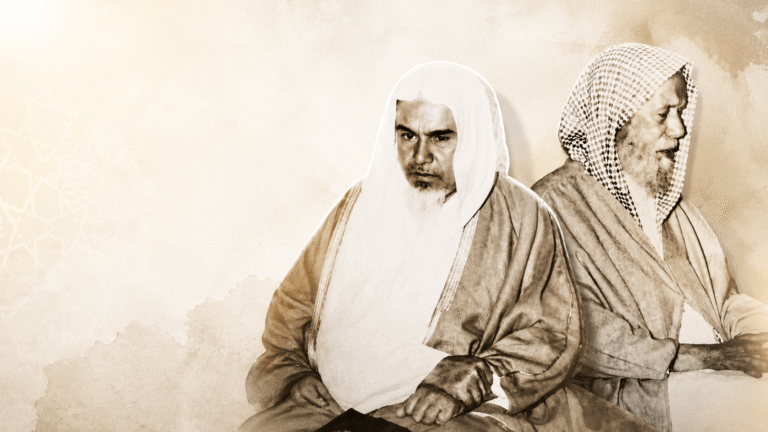
How two titans of the Salafī tradition closed the door of discord in forty years of unbreakable brotherhood
Introduction
Among the most instructive episodes in the modern history of Salafī scholarship is the brief but illuminating dispute that arose between two of its foremost figures: Shaykh Aḥmad Muḥammad Shākir (d. 1377 AH/1958 CE), may Allah have mercy upon him, and Shaykh Muḥammad Ḥāmid al-Fiqī (d. 1378 AH/1959 CE), may Allah have mercy upon him,. What makes this episode remarkable is not the disagreement itself, but the speed, wisdom, and sincerity with which both men resolved it, leaving behind a model of Salafī brotherhood that the ummah sorely needs in every age.
Background to the Dispute
The origins of the disagreement lay in a scholarly matter. Shaykh Ḥāmid al-Fiqī had attributed certain editorial comments to a passage written by Shaykh al-Islam Aḥmad ibn ʿAbd al-Ḥalīm Ibn Taymiyyah (d. 728 AH/1328 CE) concerning the jinn. Shaykh Aḥmad Shākir read these comments and formed the impression that his colleague was implicitly calling Ibn Taymiyyah a liar, a charge of the gravest order in the Salafī tradition, where veneration of the major scholars of the Ahl as-Sunnah is a matter of principle.
Acting on this understanding, Shaykh Aḥmad Shākir composed a formal rebuttal and dispatched it to Shaykh al-Fiqī for publication in Majallat al-Hudā an-Nabawī, the journal which al-Fiqī edited. The article was not published. What Shaykh Shākir did not know, however, was that similar concerns about the same passage had been raised by several other brothers from Anṣār as-Sunnah al-Muḥammadiyyah. Shaykh al-Fiqī had received these communications and composed a single general response, naming no individual, which he published in the journal.
When Shaykh Aḥmad Shākir read this published response, he concluded, given that it addressed the very arguments he had raised and in roughly the same order, that it was directed specifically at him. The refusal to publish his article, combined with the appearance of a public response he believed to be aimed at him without any prior notification, was deeply felt. Adding to his sense of grievance was the fact that the two scholars had met on the evening of ʿĪd al-Fiṭr of that year, and not a word was said to him about the article or its general intent. The following morning, 2 Shawwāl 1374 AH, when the journal arrived by post, he found the piece and concluded that it had been directed at him alone.
This prompted Shaykh Aḥmad Shākir to write his well-known letter, Baynī wa-Bayna ash-Shaykh Ḥāmid al-Fiqī (“Between Me and Shaykh Ḥāmid al-Fiqī”), in which he responded with notable sharpness. As the author of the contextual account below observes, those who have read this letter will know that Shaykh Shākir’s tone was severe. Had Allah not blessed both men with reason, forbearance, and wisdom, a fitnah of incalculable proportion might have followed.
Shaykh Ḥāmid al-Fiqī’s Response
Shaykh al-Fiqī responded in Majallat al-Hudā an-Nabawī (Vol. 19, Issues 11–12, Dhū al-Qaʿdah and Dhū al-Ḥijjah 1374 AH) under the heading of the Qurʾānic verse:
Allah says:
وَلَمَن صَبَرَ وَغَفَرَ إِنَّ ذَٰلِكَ لَمِنۡ عَزۡمِ ٱلۡأُمُورِ
“And whoever is patient and forgives, indeed, that is among the matters requiring resolve” [Q 42:43]
.
He wrote:
My brothers, who are likewise brothers to Shaykh Aḥmad Shākir, were greatly alarmed when they read what had been written. They grieved deeply and asked me with urgency and sorrow: what stands between you and your lifelong brother that has given rise to this discord?
I say, and affirm emphatically, that what stands between me and my lifelong brother is precisely that upon which we have lived throughout our years together, under the shade of this brotherhood, firm in its bonds and strong in its ties, for it was woven, by the praise of Allah , on the loom of knowledge, and threaded from the strands of the madhhab of the Pious Predecessors (may Allah be pleased with them). The hand that wove and fashioned it was the hand of the Qurʾān and the sunnah. We, by the praise of Allah , and despite every envier and malice-bearer, continue to be clothed in this noble garment and to enjoy its adornment and its piety. We ask Allah to keep this garment upon us, full and complete, until we meet Him thus, and we shall not leave any opening for those who seek to sow discord and fan the flames of strife.
My brother Shaykh Aḥmad Shākir knows with certainty that his brother Ḥāmid is the most aware of people of his virtue, the most grateful for his kindness, the most patient in friendship with him, the most faithful in keeping his covenant, the most earnest in preserving his affection, the furthest from causing him harm, and the quickest to bring him joy. However much Satan may seek to drive a wedge between us, the return to the fortress of affection, Allah willing, is swift, and the Salafī brotherhood is well-suited to hasten that return.
I ask my Lord, Glorified be He, to make this my disposition with every Salafī brother who critiques me, however far his pen may stray and however excessive his criticism. I shall not commend myself by claiming, as was erroneously attributed to me, that I am the most knowledgeable or the most religiously discerning among my brothers. For I know myself, and I know that I am ever in need of new knowledge and new prophetic conduct. Allah knows what lies within hearts. The Prophet said, as narrated by Anas ibn Mālik ؓ:
كُلُّ ابْنِ آدَمَ خَطَّاءٌ وَخَيْرُ الْخَطَّائِينَ التَّوَّابُونَ
“All of mankind errs, and the best of those who err are those who repent.” (Jāmiʿ at-Tirmidhī, no. 2499).
My grievance against my brother Shaykh Aḥmad Shākir is that he thought ill of his lifelong brother in Allah and attributed to him what he himself knows is furthest from his nature and most repugnant to him, especially with regard to a brother whose covenant he keeps and whose brotherhood and affection he holds dear. He knows that I detest injustice; indeed, I am incapable of it and have no aptitude for it, let alone that I would wrong my brother Shaykh Aḥmad Shākir. Perhaps it is he who wronged himself by acting hastily and writing without pause, when it would have been more befitting to reflect, he who is an experienced judge.
Words had reached me from more than one of my brothers from Anṣār as-Sunnah, just as they had reached me from him, drawing my attention to the matter concerning Shaykh al-Islam Ibn Taymiyyah (may Allah have mercy on him). I wrote my response and kept it concise, so that each of them might find his answer therein. For that reason I did not mention any of them by name, as there was no need, since they had written for the sake of knowledge and truth, not for themselves. Then came a Ṣaʿīdī-tempered outburst from my brother Shaykh Aḥmad Shākir, may Allah forgive me and him, which Satan seized upon as a means to drive a wedge between us. My brother came to recognise this and sought forgiveness. And Allah forgives me and him and the believers.
Finally, let all know: there is nothing between me and my brother Shaykh Aḥmad Shākir but a constant return, Allah willing, to Allah and to His Messenger . I am most earnest in sealing breaches and consolidating efforts, directing them towards the enemies of Allah and His Messenger , for they are our true enemies, especially in this era. And it is for this reason that I am most keen to embody what Allah says to His believing servants:
Allah says:
وَلۡيَعۡفُواْ وَلۡيَصۡفَحُوٓاْۗ أَلَا تُحِبُّونَ أَن يَغۡفِرَ ٱللَّهُ لَكُمۡۚ وَٱللَّهُ غَفُورٞ رَّحِيمٌ
“And let them pardon and overlook. Would you not love for Allah to forgive you? And Allah is Forgiving and Merciful” [Q 24:22, excerpt]
, and
Allah says:
وَلَمَن صَبَرَ وَغَفَرَ إِنَّ ذَٰلِكَ لَمِنۡ عَزۡمِ ٱلۡأُمُورِ
“And whoever is patient and forgives, indeed, that is among the matters requiring resolve” [Q 42:43]
.
We seek refuge in Allah from the evil of our own souls and from the misdeeds of our actions, and we ask Him, Glorified be He, for guidance, faith, steadfastness, rectitude, right conduct, and mutual exhortation to truth and patience. And may Allah’s peace and blessings be upon our Imām Muḥammad and upon his family.
Shaykh Aḥmad Shākir’s Response
Since my brother Shaykh Ḥāmid al-Fiqī has expressed his grievance over what I wrote, I concede the point to him. I would never wish for there to be between us bitter contention in dispute, nor indeed would I wish this between myself and any person. It is no small matter to demolish a longstanding friendship and brotherhood in Allah , forged in the service of Islam and the struggle against its enemies.
Yet I believe, nay I am certain, that had my brother Shaykh Ḥāmid considered the matter from another angle, from my perspective, and reflected upon the circumstances that compelled me to write and led me to take this position, he would have excused me to some degree. He would have understood that the matter was not a mere Ṣaʿīdī outburst, but rather a response to what I perceived as an injustice. Since he has disavowed it, all praise is due to Allah for this clarification.
Among my reasons, as I saw it at the time, was that a conversation had taken place between us regarding my article and whether he would publish it, and he declined. The worst I could have imagined, and the harshest assumption I could have held regarding my article, was that he would simply set it aside and not publish it. That very conversation was a fitting opportunity, indeed it was incumbent upon him, to inform me that similar correspondence had reached him from others among our brothers on this same matter. Had he done so, I would have suspected nothing, nor would I have understood his published response to be directed at me. But as he did not, I had every reason to conclude that his article was aimed at me alone, particularly since it addressed, in roughly the same order, all the arguments I had raised in my own piece. My certainty was further reinforced when we met on the evening of ʿĪd al-Fiṭr and he said nothing to me of what he had written, despite every reason to do so. Then, the following morning, 2 Shawwāl 1374 AH, when the journal arrived by post, I found his response within it. He did not speak to me thereafter about his article, nor inform me that he had not intended me alone, but was replying in general to what had been sent to him from various correspondents. How was I to know otherwise?
For that reason I said to him, and I am sincere in what I say, had he informed me of any of this, I would not have written, regardless of whatever indications suggested that his response was directed at my article rather than published in its own right.
These are some of the circumstances that prompted me to write. There was never any individual who sought to sow discord between us or stoke the fires of fitnah. Nor am I among those who would yield to such influences even if they existed, and he knows with certainty that such attempts had been made over a long period, without effect on either of us. All praise is due to Allah in every circumstance. Had such things had any effect, this friendship and brotherhood would not have endured so long, yet it stood firm and unshaken for over forty years. Let our brothers be reassured about what stands between us.
As for scholarly debate founded upon following evidence and upholding the truth, it has no bearing on the bond between brothers, however much their views and perspectives may differ. We are all students of knowledge, all seekers of truth, all guided, to the best of our ability, by the Qurʾān and the sunnah, all of us sincere in intention and purpose, Allah willing. How often have we engaged one another in scholarly exchange and differed; how often have we researched and diverged in our views, all in pursuit of a single goal and upon a single guidance. Among us is the one who errs and the one who is correct. Often, the one who errs finds his way back, when illuminated by the light of Allah and guided by the Book of Allah and the sunnah of His Messenger .
We ask Allah to show us the path of guidance and the way of right conduct; to grant us the ability to hold firm to what He has commanded; to protect us from error and guard us from misguidance and deviation; and to make us those who guide and are guided, granted success in beneficial knowledge and righteous deeds. He is the One who hears supplication.
Closing Reflection
How greatly the ummah stands in need today of such noble character, wisdom, and restraint. In an age where disagreements are often prolonged, amplified, and transformed into causes of division, the conduct of the scholars of old serves as a powerful reminder of what sincere brotherhood and concern for the religion truly look like.
May Allah shower His vast mercy upon Shaykhs Aḥmad Shākir and Ḥāmid al-Fiqī. Though a dispute arose between them, they did not allow it to fester or evolve into a prolonged conflict. Rather, they swiftly closed the door of fitnah before it could widen, denying agitators and partisans any opportunity to inflame tensions or sow discord among the people. They returned to one another with sincerity, mutual respect, and genuine brotherhood, placing the interests of Islam and the Salafī daʿwah above personal grievances and differences.
Had it not been for the mercy of Allah and the wisdom He placed in their hearts, matters could have unfolded very differently. Their disagreement might have spiralled into years of public refutations, counter-refutations, and increasingly bitter exchanges. Such disputes, when left unchecked, rarely remain confined to the scholars themselves; rather, they often spread among students and followers, fragmenting ranks, breeding suspicion, and consuming energies that ought to be devoted to knowledge, daʿwah, and worship.
Instead, these two noble scholars demonstrated a profound understanding of the higher objectives of the sharīʿah and the responsibilities borne by those whom Allah has placed in positions of influence. They recognised that preserving brotherhood, protecting the unity of the people of sunnah, and safeguarding the fruits of decades of collective effort were greater priorities than personal vindication or victory in argument.
The Salafīs of Egypt had spent many years laying foundations, spreading authentic knowledge, reviving the sunnah, and calling the people to the methodology of the Salaf. A prolonged conflict between two of its foremost scholars could have weakened that work and jeopardised much of what had been painstakingly built. Yet Allah decreed otherwise. Through His grace, reconciliation prevailed over estrangement, and mutual affection overcame disagreement.
There is a profound lesson here for students of knowledge, callers to Allah, and Islamic movements in every generation. Not every disagreement must become a battle, nor every mistake a cause for permanent estrangement. The truly successful are those who know when to speak, when to remain silent, when to clarify, and when to overlook; those who seek the pleasure of Allah rather than the triumph of the self.
Shaykh Aḥmad Shākir passed away only three years after this episode, and Shaykh Ḥāmid al-Fiqī followed him a year later. Their reconciliation stands as one of the final chapters of their lives – a testimony to their sincerity, humility, and concern for the religion. They departed from this world having preserved their brotherhood and left behind an example worthy of reflection and emulation.
May Allah envelop them both in His boundless mercy, forgive their shortcomings, elevate their ranks among the righteous, and reward them abundantly for their service to Islam and the Muslims. May He grant the scholars, students of knowledge, and callers of our time a portion of their wisdom, humility, and noble conduct. Āmīn.
References
Al-Qurʾān al-Karīm, Q 24:22 (excerpt) and 42:43.
Al-Fiqī, Muḥammad Ḥāmid (d. 1378 AH/1959 CE). Wa-laman Ṣabara wa-Ghafara inna Dhālika lamin ʿAzm al-Umūr. Majallat al-Hudā an-Nabawī, vol. 19, issues 11–12, Dhū al-Qaʿdah and Dhū al-Ḥijjah 1374 AH.
Shākir, Aḥmad Muḥammad (d. 1377 AH/1958 CE). Baynī wa-Bayna ash-Shaykh Ḥāmid al-Fiqī. Published rejoinder appended to al-Fiqī’s response in Majallat al-Hudā an-Nabawī, vol. 19, issues 11–12, 1374 AH.
At-Tirmidhī, Muḥammad ibn ʿĪsā (d. 279 AH/892 CE), Jāmiʿ at-Tirmidhī, no. 2499. Narrated by Anas ibn Mālik.