The Definition and Nature of Custody
Custody (ḥaḍānah) refers to the care, protection, and upbringing of one who is unable to manage his or her own affairs. It includes safeguarding the child from harm, nurturing and raising them appropriately, providing food and drink, maintaining cleanliness, washing their clothing, applying oil where appropriate, and attending to their sleep, health, and general welfare.
Custody is a legal obligation in the sharīʿah, because neglecting it exposes the child to harm and possible destruction. Where several eligible custodians exist, this obligation is communal (farḍ kifāyah). If only one qualified custodian exists, or the child accepts no one else, then it becomes an individual obligation (farḍ ʿayn).
Custody is also a right belonging to the eligible custodian. If that person is not specifically designated and chooses to forgo this right, they cannot be compelled to undertake it. If they relinquish their right, it passes to the next person entitled to custody.
The Mother’s Primary Right to Custody
When the marriage remains intact, custody belongs jointly to both parents. If the marriage ends through divorce or the death of the father, then, by scholarly consensus, custody belongs to the mother. There is no difference of opinion among the scholars on this point, provided there is no legal impediment preventing her from exercising that right.
This is based on the narration of ʿAbd Allah ibn ʿAmr ibn al-ʿĀṣ, in which a woman came to the Messenger of Allah and said:
يَا رَسُولَ اللَّهِ إِنَّ ابْنِي هَذَا كَانَ بَطْنِي لَهُ وِعَاءً وَثَدْيِي لَهُ سِقَاءً وَحِجْرِي لَهُ حِوَاءً وَإِنَّ أَبَاهُ طَلَّقَنِي وَأَرَادَ أَنْ يَنْتَزِعَهُ مِنِّي
“O Messenger of Allah, this son of mine, my womb was a vessel for him, my breast was a source of nourishment for him, and my lap was a refuge for him. His father has divorced me and wishes to take him away from me.” (Sunan Abī Dāwūd, no. 2276).
The Prophet replied:
أَنْتِ أَحَقُّ بِهِ مَا لَمْ تَنْكِحِي
“You have more right to him so long as you do not remarry.” (Sunan Abī Dāwūd, no. 2276).
This was recorded by Imām Aḥmad ibn Ḥanbal (d. 241 AH/855 CE), may Allah have mercy upon him, in al-Musnad and by Abū Dāwūd Sulaymān ibn al-Ashʿath as-Sijistānī (d. 275 AH/889 CE), may Allah have mercy upon him, in his Sunan.
Muḥammad ibn Abī Bakr ibn Qayyim al-Jawziyyah (d. 751 AH/1350 CE), may Allah have mercy upon him, commented on this narration, stating:
أن هذا الحديث دل على أنه إذا افترق الأبوان وبينهما ولد فأمه أحق به من الأب ما لم يقم بالأم ما يمنع تقديمها أو بالولد وصف يقتضي تخييره وهذا ما لا يعرف فيه نزاع
“This ḥadīth indicates that when the parents separate while they have a child between them, the mother has more right to the child than the father, unless there exists a factor preventing her from being given precedence, or there is a characteristic in the child requiring that he be given the choice. No disagreement is known concerning this.” [Ibn al-Qayyim, Zād al-Maʿād fī Hady Khayr al-ʿIbād, discussion of custody.]
He further noted that Abū Bakr ʿAbd Allah ibn Abī Quḥāfah aṣ-Ṣiddīq ruled accordingly against ʿUmar ibn al-Khaṭṭāb on this very matter, and no Companion objected to his judgement. Imām Mālik ibn Anas (d. 179 AH/795 CE), may Allah have mercy upon him, recorded this incident in al-Muwaṭṭaʾ: ʿUmar had divorced a woman from the Anṣār who had borne him his son ʿĀṣim. He later came to Qubāʾ and found the boy playing in the courtyard of the mosque, and took hold of his arm to place him upon his own riding animal. The boy’s grandmother pursued him and disputed the matter until they both came before Abū Bakr aṣ-Ṣiddīq. ʿUmar said:
“He is my son.” [Mālik, al-Muwaṭṭaʾ, report concerning the custody of ʿĀṣim.]
The woman said:
“He is my son.” [Mālik, al-Muwaṭṭaʾ, the same report.]
Abū Bakr ruled:
“Leave him with her.” [Mālik, al-Muwaṭṭaʾ, the same report.]
and ʿUmar did not object further. When ʿUmar later became Caliph, he himself ruled in the same manner in similar cases.
The Order of Precedence and the Age of Discernment
The person most entitled to the custody of a child after the separation of the spouses is the child’s mother. If she remarries, custody passes to the maternal grandmother. If the maternal grandmother is unavailable, it passes to the paternal grandmother, since custody primarily belongs to the women of the family, as the mother is more compassionate towards her child than anyone else.
The scholars differed considerably regarding the age at which the mother’s primary right to custody comes to an end. The view that appears strongest is that the mother retains the greater right to custody until the child reaches the age of discernment (tamayyuz). Once the child reaches that stage, he or she is given the choice between the parents.
This is supported by the ḥadīth of Abū Hurayrah, who narrated that the Messenger of Allah gave a young boy the choice between his father and his mother. This was recorded by the compilers of the Sunan, and Imām Muḥammad ibn ʿĪsā at-Tirmidhī (d. 279 AH/892 CE), may Allah have mercy upon him, graded it authentic.
Abū Hurayrah also narrated that a woman came to the Prophet and said:
يَا رَسُولَ اللَّهِ إِنَّ زَوْجِي يُرِيدُ أَنْ يَذْهَبَ بِابْنِي وَقَدْ سَقَانِي مِنْ بِئْرِ أَبِي عِنَبَةَ وَقَدْ نَفَعَنِي
“O Messenger of Allah, my husband wishes to take away my son, yet he has brought me water from the well of Abū ʿInabah and has been of benefit to me.” (Sunan Abī Dāwūd, no. 2277).
The Messenger of Allah said:
اسْتَهِمَا عَلَيْهِ
“Cast lots concerning him.” (Sunan Abī Dāwūd, no. 2277).
Her husband then said:
مَنْ يُحَاقُّنِي فِي وَلَدِي
“Who will dispute with me regarding my child?” (Sunan Abī Dāwūd, no. 2277).
The Messenger of Allah said:
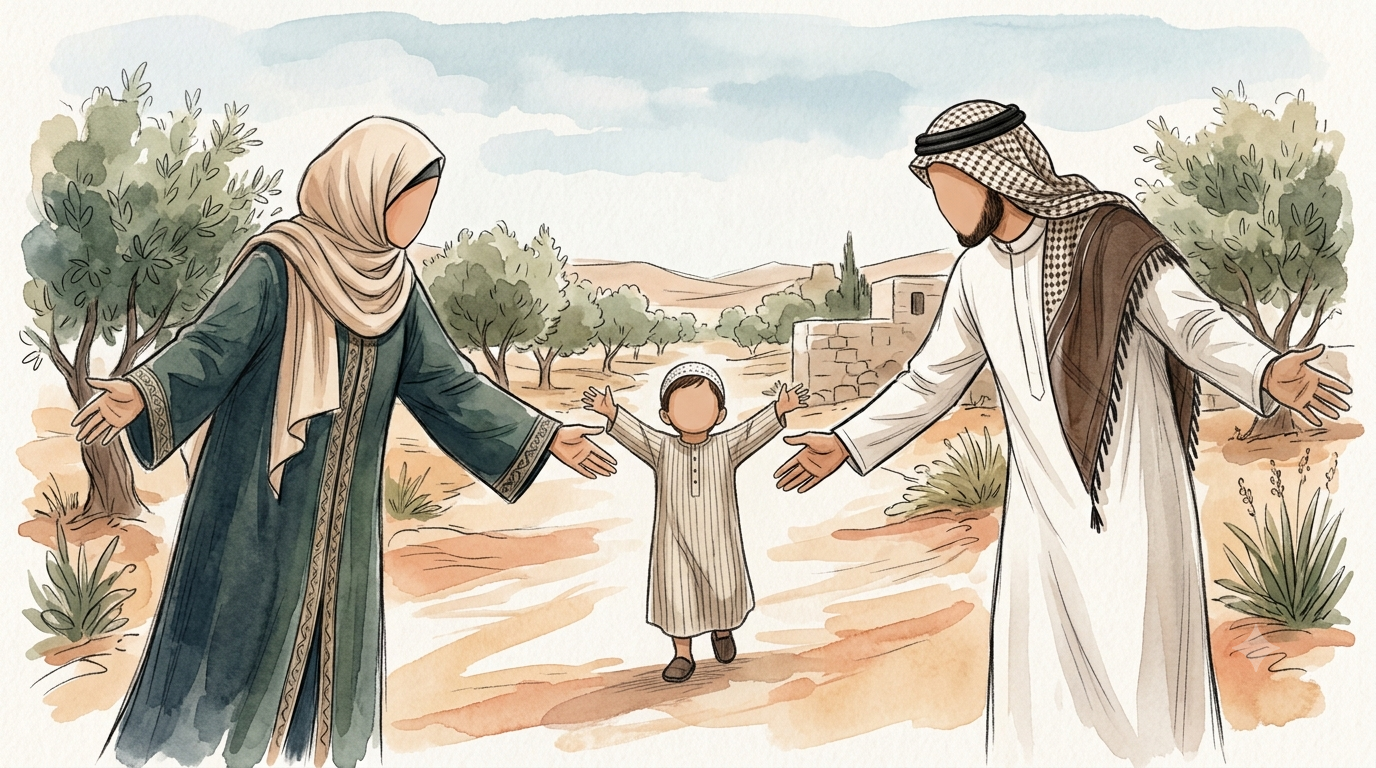
هَذَا أَبُوكَ وَهَذِهِ أُمُّكَ فَخُذْ بِيَدِ أَيِّهِمَا شِئْتَ
“This is your father and this is your mother, so take the hand of whichever of them you wish.” (Sunan Abī Dāwūd, no. 2277; Jāmiʿ at-Tirmidhī, no. 1357, related narration).
The child took his mother’s hand, and she departed with him. Imām at-Tirmidhī described this narration as ḥasan ṣaḥīḥ.
The Permanent Committee for Scholarly Research and Fatwas, in an official ruling issued according to the madhhab of Imām Aḥmad ibn Ḥanbal (fatwā no. 14806), confirmed this order of precedence: when a boy reaches the age of seven, he is given the choice between his father and his mother, and he remains with whichever of the two he chooses. When a girl reaches the age of seven, her father has the greater right to her custody, because she is in need of protection and safeguarding, while the mother herself requires someone to protect her. This ruling was signed by Shaykh ʿAbd al-ʿAzīz ibn ʿAbd Allah ibn Bāz (d. 1420 AH/1999 CE), may Allah have mercy upon him, as Chairman, alongside Shaykh ʿAbd ar-Razzāq ʿAfīfī (d. 1415 AH/1994 CE), may Allah have mercy upon him, Shaykh ʿAbd Allah ibn ʿAbd ar-Raḥmān Āl Ghudayyān (d. 1431 AH/2010 CE), may Allah have mercy upon him, Shaykh Ṣāliḥ ibn Fawzān al-Fawzān, may Allah preserve him, and Shaykh ʿAbd al-ʿAzīz ibn ʿAbd Allah ibn Muḥammad Āl ash-Shaykh (d. 1447 AH/2025 CE), may Allah have mercy upon him.
When the Welfare of the Child Overrides the Standard Order
However, neither a boy nor a girl should remain in the custody of someone who does not protect them or look after their welfare, even if that person would ordinarily hold the greater right to custody according to the established order of precedence. This is the madhhab of Imām Aḥmad ibn Ḥanbal, and it was reaffirmed in the Permanent Committee’s ruling cited above.
Shaykh Muḥammad ibn Ṣāliḥ al-ʿUthaymīn (d. 1421 AH/2001 CE), may Allah have mercy upon him, explained this principle further when asked with whom children should remain following a separation. He stated that they should remain with whomever the sharīʿah judge rules to be in their best interest, should the parents fail to agree. He emphasised that the objective of custody is to safeguard and nurture the welfare of the child, and it is therefore impermissible for a child to remain in the custody of someone who is neglectful, unconcerned with the child’s welfare, or involved in sinful conduct, regardless of that person’s formal precedence. Such a person forfeits their right to custody, and the matter returns to the judge, who must fear Allah and give due consideration to the welfare and best interests of the child.
Shaykh ʿAbd al-ʿAzīz ibn Bāz was asked a related question concerning the apparent variation across different aḥādīth, in which the Prophet awarded custody in different cases to the father, to the mother, jointly, or by the child’s own choice. He explained that these differing outcomes reflect the fact that custody is a matter requiring careful examination of each individual case: it may be that the father is righteous while the mother is not, in which case he is more deserving of custody, or the reverse may be true. Such matters, he concluded, are best left to qualified judges, who can assess the particular circumstances of each case as they arise.
The Prohibition of Preventing Contact Between Parent and Child
A distinct but closely related matter concerns the right of the non-custodial parent to maintain contact with the child. ʿAbd Allah ibn Aḥmad ibn Qudāmah al-Maqdisī (d. 620 AH/1223 CE), may Allah have mercy upon him, stated plainly:
ولا يمنع أحدهما من زيارتها عند الآخر
“Neither parent should be prevented from visiting the child whilst the child is with the other.” [Ibn Qudāmah, al-Mughnī, discussion of custody.]
This is because preventing such visitation leads to the severing of family ties, a matter for which severe warnings have been transmitted in the sunnah.
Jubayr ibn Muṭʿim narrated that the Prophet said:
لاَ يَدْخُلُ الْجَنَّةَ قَاطِعٌ
“The one who severs the ties of kinship will not enter Paradise.” (Ṣaḥīḥ al-Bukhārī, no. 5984).
Abū Hurayrah also narrated that the Messenger of Allah said:
خَلَقَ اللَّهُ الْخَلْقَ، فَلَمَّا فَرَغَ مِنْهُ قَامَتِ الرَّحِمُ فَأَخَذَتْ بِحَقْوِ الرَّحْمَنِ
“Allah created the creation, and when He had finished, the womb stood and clung to the Most Merciful…” (Ṣaḥīḥ al-Bukhārī, no. 4830, excerpt).
The ḥadīth concludes with Allah saying:
أَلاَ تَرْضَيْنَ أَنْ أَصِلَ مَنْ وَصَلَكِ وَأَقْطَعَ مَنْ قَطَعَكِ
“Are you not pleased that I maintain ties with whoever maintains you and sever ties with whoever severs you?” (Ṣaḥīḥ al-Bukhārī, no. 4830, excerpt).
Abū Hurayrah then recited:
فَهَلْ عَسَيْتُمْ إِن تَوَلَّيْتُمْ أَن تُفْسِدُوا فِي الْأَرْضِ وَتُقَطِّعُوا أَرْحَامَكُمْ أُولَـٰئِكَ الَّذِينَ لَعَنَهُمُ اللَّهُ فَأَصَمَّهُمْ وَأَعْمَىٰ أَبْصَارَهُمْ
“Would you then, if you were given authority, cause corruption in the land and sever your ties of kinship? They are the ones whom Allah has cursed, making them deaf and blinding their sight.” [Q 47:22–23]
Shaykh Ibn ʿUthaymīn was asked directly about a mother who had been divorced for nine years, throughout which the father had prevented her children from visiting her entirely. He addressed the father first, stating plainly that it is not permissible for him to prevent his children from visiting their mother. While he may have the right to prevent her from visiting them in his own home, since the house belongs to him, he has no right to prevent the children themselves from visiting her in her own home. He warned that such a man, who has come between a mother and her children, may be punished by Allah , such that Allah causes separation between him and those most beloved to him, whether in this world or the Hereafter, asking rhetorically what harm it would cause him for the children to visit their mother for even a day or two each week. As for the mother in such a situation, he counselled her to remain patient, seek her reward with Allah , and supplicate that Allah incline the father’s heart towards permitting the children to visit her.
Custody as a Renewable Right
The al-Mawsūʿah al-Fiqhiyyah al-Kuwaytiyyah notes that custody may cease because the person entitled to it relinquishes that right. If the custodian later returns and requests custody, the request is accepted, because custody is a right that renews with the passage of time, just as maintenance does. Likewise, if custody was prevented due to an impediment, such as insanity, immorality, illness, or another obstacle, then once the impediment ceases, the right returns, in accordance with the legal maxim:
إذا زال المانع عاد الممنوع
“When the impediment is removed, the original ruling returns.” [al-Mawsūʿah al-Fiqhiyyah al-Kuwaytiyyah, vol. 17, p. 317.]
References
Al-Qurʾān al-Karīm, Sūrat Muḥammad, verses 22–23.
Abū Dāwūd, Sulaymān ibn al-Ashʿath as-Sijistānī (d. 275 AH/889 CE), Sunan Abī Dāwūd, nos. 2276–2277.
Aḥmad ibn Ḥanbal (d. 241 AH/855 CE), al-Musnad, no. 2804. Aḥmad Muḥammad Shākir (d. 1377 AH/1958 CE) and Muḥammad Nāṣir ad-Dīn al-Albānī (d. 1420 AH/1999 CE), citing as-Silsilah aṣ-Ṣaḥīḥah, no. 2382.
Al-Albānī, Muḥammad Nāṣir ad-Dīn (d. 1420 AH/1999 CE), as-Silsilah aṣ-Ṣaḥīḥah, no. 2382; vol. 1, p. 498. References and authentication retained from the source article; edition not specified.
Al-Bukhārī, Muḥammad ibn Ismāʿīl (d. 256 AH/870 CE), Ṣaḥīḥ al-Bukhārī, nos. 4830 and 5984.
Al-Ḥākim, Muḥammad ibn ʿAbd Allah an-Naysābūrī (d. 405 AH/1014 CE), al-Mustadrak ʿalā aṣ-Ṣaḥīḥayn, vol. 2, pp. 57–58. Declared authentic according to the conditions of Muslim by al-Ḥākim, and authenticated by al-Albānī in as-Silsilah aṣ-Ṣaḥīḥah, vol. 1, p. 498.
Ibn al-Qayyim al-Jawziyyah, Muḥammad ibn Abī Bakr (d. 751 AH/1350 CE), Zād al-Maʿād fī Hady Khayr al-ʿIbād, Beirut: Muʾassasat ar-Risālah; and Miftāḥ Dār as-Saʿādah, vol. 2, p. 905.
Ibn Bāz, ʿAbd al-ʿAzīz ibn ʿAbd Allah (d. 1420 AH/1999 CE), Nūr ʿalā ad-Darb.
Ibn Qudāmah al-Maqdisī, ʿAbd Allah ibn Aḥmad (d. 620 AH/1223 CE), al-Mughnī, Riyadh: Dār ʿĀlam al-Kutub.
Ibn ʿUthaymīn, Muḥammad ibn Ṣāliḥ (d. 1421 AH/2001 CE), Liqāʾ al-Bāb al-Maftūḥ, no. 229.
Mālik ibn Anas (d. 179 AH/795 CE), al-Muwaṭṭaʾ, report concerning the custody of ʿĀṣim ibn ʿUmar.
Ministry of Awqāf and Islamic Affairs, Kuwait, al-Mawsūʿah al-Fiqhiyyah al-Kuwaytiyyah, vol. 17, p. 317.
Permanent Committee for Scholarly Research and Fatwas, fatwā no. 14806, vol. 21, pp. 193–195, signed by Shaykh ʿAbd al-ʿAzīz ibn Bāz (Chairman), Shaykh ʿAbd ar-Razzāq ʿAfīfī (Vice Chairman), Shaykh ʿAbd Allah ibn Ghudayyān, Shaykh Ṣāliḥ al-Fawzān and Shaykh ʿAbd al-ʿAzīz Āl ash-Shaykh.
At-Tirmidhī, Muḥammad ibn ʿĪsā (d. 279 AH/892 CE), Jāmiʿ at-Tirmidhī, no. 1357. Graded ḥasan ṣaḥīḥ by at-Tirmidhī.