
Based on the account of ʿIzz ad-Dīn Abū al-Ḥasan ʿAlī ibn Muḥammad Ibn al-Athīr al-Jazarī (d. 630 AH/1233 CE):
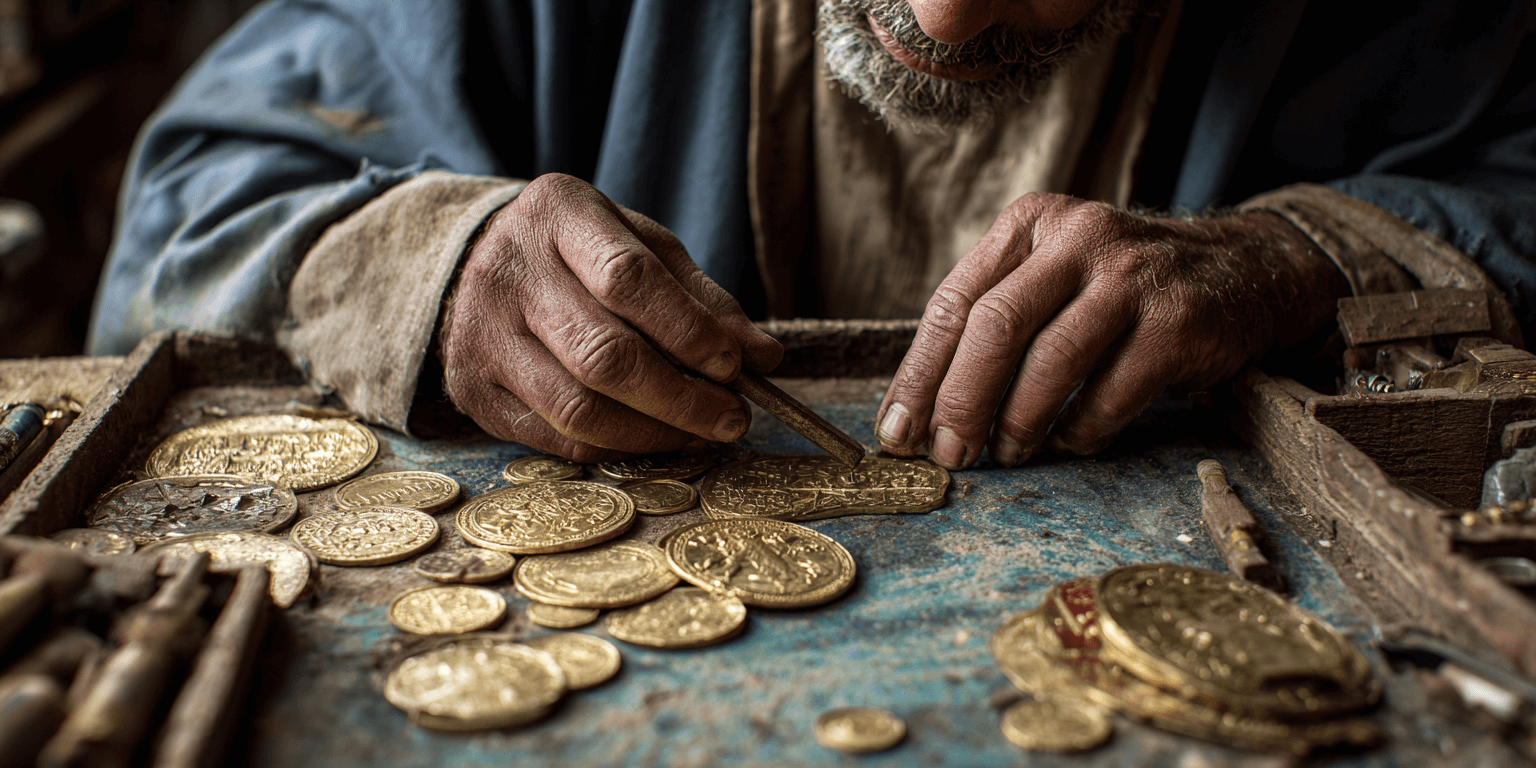
In 76 AH/695–696 CE, ʿAbd al-Malik ibn Marwān ordered the minting of dīnārs and dirhams. In this account, he is regarded as the first to establish distinctly Islamic coinage. This measure proved highly beneficial for the people.
The reason for this development was that he instructed that correspondence sent to the Romans begin with the Qurʾānic declaration:
قُلْ هُوَ اللَّهُ أَحَدٌ
“Say: ‘He is Allah, One.’” [Q 112:1]
Mention of the Prophet and the date was also included.
This displeased the Roman Emperor, who wrote in response:
إنكم قد أحدثتم كذا وكذا فاتركوه وإلا أتاكم في دنانيرنا من ذكرنا نبيكم ما تكرهون
“You have made certain changes. Abandon them, or you will find in our dīnārs a mention of your Prophet that will displease you.” Al-Kāmil fī at-Tārīkh, events of 76 AH.
This threat weighed heavily upon ʿAbd al-Malik. He summoned Khālid ibn Yazīd ibn Muʿāwiyah and consulted him. Khālid advised:
حرم دنانيرهم واضرب للناس سكة فيها ذكر الله تعالى
“Forbid their dīnārs and strike coins for the people bearing the mention of Allah, Most High.” Same account.
Accordingly, ʿAbd al-Malik ordered the minting of Islamic dīnārs and dirhams.
Subsequently, al-Ḥajjāj ibn Yūsuf struck dirhams bearing the same Qurʾānic verse. People disapproved because the coins would be handled by those in a state of major ritual impurity (janābah) and by menstruating women. Al-Ḥajjāj prohibited anyone else from minting coins.
Despite this, a Jewish minter named Samīr struck his own dirhams. He was arrested and taken to be killed. Samīr argued:
عيار درهمي أجود من دراهمك فلم تقتلني
“The fineness of my dirham is better than that of your dirhams, so why kill me?” Same account.
Al-Ḥajjāj did not release him. Samīr then devised calibrated balance weights for the people in the hope of obtaining his release, but al-Ḥajjāj did not release him. People had not known the proper weights and had merely weighed coins against one another. Once Samīr introduced these weights, some stopped cheating others.
The first person mentioned as tightening weight controls and purifying silver more thoroughly than his predecessors was ʿUmar ibn Hubayrah, during the reign of Yazīd ibn ʿAbd al-Malik (r. 101–105 AH/720–724 CE). Later, Khālid ibn ʿAbd Allah al-Qasrī, during the reign of Hishām ibn ʿAbd al-Malik (r. 105–125 AH/724–743 CE), became even stricter.
Yūsuf ibn ʿAmr then went to excess in strictness. On one occasion, he tested the standard and found a dirham deficient by one grain (ḥabbah). He ordered one thousand lashes for each mint worker. There were one hundred workers, so one hundred thousand lashes were administered for the deficiency of one grain.
The Hubayrite (al-hubayriyyah), Khalidite (al-khālidiyyah) and Yusufite (al-yūsufiyyah) dirhams were regarded as the finest Umayyad coinage. The ʿAbbāsid Caliph al-Manṣūr (r. 136–158 AH/754–775 CE) would accept no other coins in land-tax receipts (kharāj).
The earliest coins came to be known as ‘the disliked coinage’. An alternative view was that this term referred specifically to the coins struck by al-Ḥajjāj, because scholars objected to their being handled by those in janābah and menstruating women.
Before Islamic standardisation, Persian dirhams varied in size and weight. Some weighed twenty qīrāṭs, others twelve and others ten. When Islamic coinage was introduced, these three weights were combined, giving forty-two qīrāṭs. One-third was adopted as the standard, namely fourteen qīrāṭs per dirham. Thus, ten dirhams weighed seven mithqāls.
It has also been reported that Muṣʿab ibn az-Zubayr minted a small number of dirhams during the reign of his brother ʿAbd Allah ibn az-Zubayr (r. 64–73 AH/683–692 CE). These were later broken up during ʿAbd al-Malik’s reign. Ibn al-Athīr regarded the first account as more accurate: that ʿAbd al-Malik was the first to mint Islamic dīnārs and dirhams.
This reform marked a major development in Islamic governance, economic stability and political independence. It freed the Muslim polity from reliance upon foreign currencies and affirmed the distinct religious and civilisational identity of the Islamic state.
References
Al-Qurʾān, 112:1.
ʿIzz ad-Dīn Abū al-Ḥasan ʿAlī ibn Muḥammad Ibn al-Athīr al-Jazarī, Al-Kāmil fī at-Tārīkh, events of 76 AH, section on minting Islamic dīnārs and dirhams vol. 4, pp. 167–169.