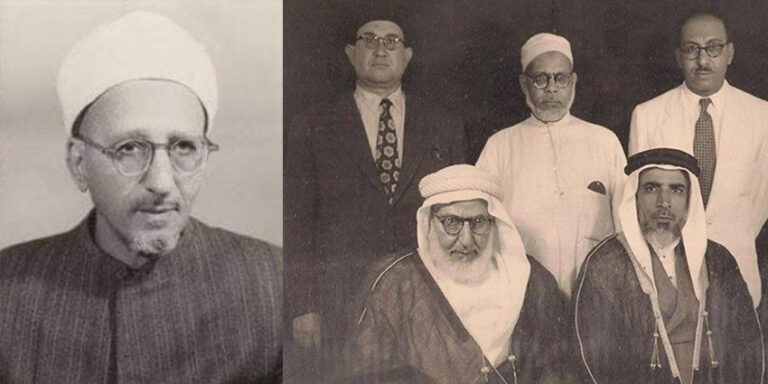
Daʿwat al-Ḥaqq magazine, issue no. 3, sent its correspondent to the Royal Hotel to congratulate Dr Taqī ad-Dīn al-Hilālī (d. 1408 AH/1987 CE), on behalf of the magazine, upon his safe return to his homeland after an absence of thirty-five years, and to convey the magazine’s wishes to him for good health and a pleasant stay.
The magazine’s correspondent wrote the following after this meeting:
I entered Dr Taqī ad-Dīn’s room at the Royal Hotel, and found myself before a man of humble bearing in his manner, his speech, and his movements, simple in his appearance, who greets you first with salām and welcomes you in a manner that makes you feel, from the very first moment, as though you had known one another before. He puts you at ease, drawing you away from formality and into open conversation, allowing you to feel entirely free, and to open your heart fully to this man, who speaks to you with his heart before he speaks to you with his tongue. This is Dr Taqī ad-Dīn al-Hilālī: the dignified scholar, the humble man, the great heart.
I chose, in the conversation I conducted with Dr Taqī ad-Dīn, not to restrict it to a fixed set of questions, but rather to let the conversation take its own natural course, and to let the Professor speak according to his own disposition. I hope I have succeeded in summarising for you here the essence of this conversation, in the hope that you find in it something of the enjoyment I myself found in speaking with the Professor.
The Student Taqī ad-Dīn
The student Taqī ad-Dīn al-Hilālī was twenty-six years old when he left Morocco for Egypt in 1922 CE, his purpose in undertaking this journey being to seek knowledge, and the science of ḥadīth in particular. He made for al-Azhar, but did not find what he sought there, and so he ceased attending it, and his connection instead grew stronger with Shaykh Rashīd Riḍā (d. 1354 AH/1935 CE) and his students. In the private gatherings of Shaykh Rashīd Riḍā**, the mind of the young Moroccan student opened up, his aptitude and eagerness for knowledge became apparent, along with his determination to acquire it whatever effort, sacrifice, or risk it might cost him. The intense discussions that took place in Shaykh Rashīd Riḍā’s gatherings were also a cause of his intellectual maturing, and his shift away from blind taqlīd towards the use of independent reasoning and the pursuit of rational evidences, away from excessive veneration of the great scholars and unquestioning acceptance of everything transmitted from them, and towards independent research, careful weighing of evidence, reliance upon the principles of uṣūl, and returning to the Qurʾān and the Sunnah. And yet something still remained unsettled within him, and the student who had left Morocco in pursuit of the science of ḥadīth continued searching for it, without finding what would fully satisfy his thirst for it.
An Ambition Accompanied by Folly
Eventually, the young Moroccan student was told: if you are serious in your pursuit of the science of ḥadīth, you must go to India. Yes, India, for it is only there that you will still find the remaining great figures among the men of ḥadīth. The Moroccan student began consulting others in order to carry out this venture, and one day, in the presence of Shaykh Muḥammad Ḥamzah, one of the students of Shaykh Rashīd Riḍā, he mentioned his determination to travel to India. Shaykh Ḥamzah said to him a phrase he still recalls to this day: “This is an ambition accompanied by folly.”
The folly here referred to the fact that a poor student, without support from anyone, was contemplating a journey to India at a time when only someone possessing considerable wealth, or at the very least a substantial sum of money, could even consider undertaking such a distant journey.
And yet, despite this, the folly became a reality, and Taqī ad-Dīn travelled to India, where he remained for fifteen months, studying under great figures among the men of ḥadīth, such as Shaykh ʿAbd ar-Raḥmān al-Mubārakfūrī (d. 1353 AH/1935 CE), the commentator on at-Tirmidhī. The Indian Shaykh mentions his Moroccan student at the end of the fourth volume of his book.
The Teacher Taqī ad-Dīn
On his way back from India, Taqī ad-Dīn al-Hilālī passed through Basra, where he met Shaykh Muḥammad al-Amīn ash-Shinqīṭī (d. 1393 AH/1973 CE), who had been a companion of Shaykh Abū Shuʿayb ad-Dukkālī (d. 1356 AH/1937 CE) in Makkah. In Basra, Taqī ad-Dīn started a family for the first time, and a school was established for him, where he taught Arabic and the religious sciences.
At around this time, ʿAbd al-ʿAzīz ibn Saʿūd (d. 1373 AH/1953 CE) had taken control of the Ḥijāz, and on the recommendation of Shaykh Rashīd Riḍā, Taqī ad-Dīn travelled to Makkah, where he stayed as a guest of ʿAbd al-ʿAzīz ibn Saʿūd for four months, before being appointed as a supervisor of teachers at the Prophet’s Mosque, and a teacher there at the same time. After two years, he moved to the Saudi Institute as a lecturer in Arabic, tafsīr, ḥadīth, and tawḥīd, according to the way of Ahl al-Ḥadīth, not the way of Ahl al-Kalām (the theologians of speculative discourse), in the Professor’s own words.
Back to India Once More
The Ḥijāz did not remain an entirely comfortable residence for Professor Taqī ad-Dīn for very long, and he left for India once again, this time at the invitation of Nadwat al-ʿUlamāʾ in India, who had summoned him to teach at its college. Dr Taqī ad-Dīn still recalls, to this day, some of his students at the college of Nadwat al-ʿUlamāʾ, among them Professor Masʿūd ʿĀlam an-Nadwī (d. 1373 AH/1954 CE), the author of the book aḍ-Ḍiyāʾ, ʿAlī Abū al-Ḥasan an-Nadwī (d. 1420 AH/1999 CE), and Professor Muḥammad Nāẓim an-Nadwī, director of Bahawalpur University in Pakistan.
The Certificate as a Passport
Professor Taqī ad-Dīn came to realise that literature and knowledge could not be fully put to use in the Islamic East without a certificate from a European university. He likened this certificate, for the scholar, to a passport for the traveller: one might be a man renowned for virtue, noble character, and freedom from anything blameworthy, yet one still cannot travel without a passport. So it was for the scholar in the Arab and Islamic East: knowledge alone was not sufficient; a scholarly certificate from a European university was indispensable, a passport was indispensable.
With only eighty dinars to his name, Taqī ad-Dīn resolved to undertake this venture once again, and travelled to Geneva, Switzerland, where he remained for a full month as a guest of the late Shakīb Arslān (d. 1365 AH/1946 CE), in the year 1936 CE.
The young Moroccan student had intended to travel to Britain to complete his studies there, encouraged by the fact that he had already learned English during his time in India. But residence and study in Britain required considerable expense, of which Taqī ad-Dīn possessed none. He eventually wrote to Prince ʿĀdil Arslān, who was residing in Britain at the time, asking him: how much would it cost, in Britain, to obtain the sustenance that merely staves off death? The Prince replied: “In this country, the sustenance that merely staves off death means death itself.”
And so the door to Britain was closed before the young Moroccan student. But one of the senior German professors, Dr Prüfer, visited Prince Shakīb and informed him that there was a vacant post for teaching Arabic at the University of Bonn in Germany, and Prince Shakīb recommended his friend Taqī ad-Dīn for the position.
In Germany
I asked Dr Taqī ad-Dīn what language he used to teach his students in Germany, and whether these German students possessed a sufficient command of Arabic to receive lectures in it. Dr Taqī ad-Dīn replied that he explained the Arabic texts to them in English, since a German university student is required to be capable of receiving instruction in at least two languages besides German, these two languages usually being French and English.
Professor Taqī ad-Dīn’s work in Germany was not confined to university teaching. He immediately set about learning German himself, and was able to sit an examination in it, which he passed successfully, obtaining a diploma in the German language. At the same time, he collaborated with some German professors in translating certain Arabic books into German, such as Kitāb al-Buldān by Muḥammad ibn al-Faqīh al-Baghdādī (d. 300 AH/912-13 CE), a work of world geography, and Ṭayf al-Khayāl by Muḥammad ibn Dāniyāl, the physician of Mosul (d. 710 AH/1310 CE).
Under particular circumstances, Taqī ad-Dīn then moved from Bonn to Berlin, becoming a lecturer at its university and a reference for the Arabic language at the radio broadcasting service. In Berlin, he undertook doctoral study, his thesis consisting of a translation, with commentary, of al-Jamāhir fī al-Jawāhir by Abū ar-Rayḥān Muḥammad ibn Aḥmad al-Bīrūnī (d. 440 AH/1048 CE). The thesis was accepted, and Taqī ad-Dīn was examined before a committee of professors in Syriac, Hebrew, and Arabic literature, ultimately earning his doctorate with the grade of ḥasan (good), thereby becoming the first Moroccan to graduate from the University of Berlin, as Professor Kienle remarked to him whilst shaking his hand in congratulation upon his success.
Under the pressure of particular circumstances, conditions in Germany no longer remained as favourable for Dr Taqī ad-Dīn as they once had been. At around this time, the Mufti of Palestine, Sayyid Amīn al-Ḥusaynī (d. 1394 AH/1974 CE), arrived in Germany, and helped Dr Taqī ad-Dīn travel to the northern part of Morocco. The Spanish authorities, in allowing him to remain in Tetouan, having already confiscated his passport, stipulated that he was not to broadcast, lecture, or write anything without their prior review, and made it clear to him that he could not even write under a pseudonym, or he would be subject to the harshest penalties.
Dr Taqī ad-Dīn remained in Tetouan until 1947 CE, after which he travelled to Iraq, where he was appointed as a lecturer, first at Queen ʿĀliyah College, and then at the Higher Teachers’ College in Baghdad, where he continues his work to this day.
Guidance for the Youth
I asked Dr Taqī ad-Dīn what guidance he wished to offer to readers, and to the youth in particular. He replied:
Firstly, hold fast to Islam. Religiosity does not mean backwardness, reactionary thinking, or any of these terms we hear thrown about carelessly and dismissively. If our youth wish to claim that Germany, for instance, is backward or reactionary, they are free to do so, but reality contradicts them. One of the sons of Dr Adenauer is a well-known monk, and the faculty of theology in every German university is the most influential faculty, the one most enjoying respect and esteem, and the professors, all of them, attend the prayers, as do the men of government, foremost among them Dr Adenauer himself.
Our youth ought to know that the government of Germany, one of the most successful governments, belongs to the Christian Democratic Party, and has governed Germany since 1948 CE, and the Social Democratic Party has striven hard to bring it down, without success to this day, and if this indicates anything, it indicates the extent of the religiosity of the German people, and their attachment to their religious government.
Indeed, the deep penetration of the religious spirit within the German people requires no proof; any traveller through Germany notices it easily, observing it in the crowds of people attending church on Sundays, and in other religious observances besides.
Secondly, I advise every Moroccan student considering travelling abroad to complete his studies not to head towards the Arab East if he wishes to study the applied and experimental sciences, medicine, engineering, pharmacy, and the like, but rather to head towards one of the scholarly capitals of Europe. I would also draw attention to the fact that we ought to have, in every scholarly capital where we have students, a supervisor appointed by the Ministry of Education, just as is the case with every other scholarly mission.
Thirdly, I would prefer, instead of sending students to universities abroad, the establishment of a university within Morocco itself, inviting professors to it from the various scholarly capitals of the world. In this way, the benefit would not be confined to the student alone, but would extend to creating a scholarly atmosphere from which the entire country could benefit. After completing his university studies, the student’s mind would have matured, his formation would be complete, and there would be less concern about him being negatively influenced by external factors that may not serve his own interests or those of his nation. At that point, he could then be sent abroad for further training and exposure.
Editorial Notes
The identification of “Dr Adenauer” as Konrad Adenauer (d. 1967 CE), the first Chancellor of West Germany, “Dr Prüfer” as very likely the German Orientalist and diplomat Curt Prüfer (d. 1959 CE), and the precise identity of “Professor Kienle,” could not all be established with equal confidence. The names above are preserved exactly as transliterated from the Arabic source; the identifications offered for Adenauer and Prüfer are editorial additions offered with reasonable confidence, not part of the original interview text, and no identification could be reliably established for Kienle.
**Rashīd Riḍā, Shaykh al-Albānī acknowledged the considerable benefit he derived from Sayyid Rashīd Riḍā, particularly through his journal al-Manār, which he regarded as instrumental in opening for him the way to the methodology of the Salaf. Nevertheless, he noted that he later identified instances in Riḍā’s writings where he had departed, to varying degrees, from what is established in the Sunnah. See: Silsilat al-Hudā wa-l-Nūr, tape no. 226, 00:12:34.
References
Daʿwat al-Ḥaqq, issue no. 3, “Ārāʾ wa Aḥādīth maʿa ad-Duktūr Taqī ad-Dīn al-Hilālī.”