
By the time Muḥammad ibn ʿAbd al-Wahhāb ibn Sulaymān at-Tamīmī (d. 1206 AH/1792 CE) had embarked upon his journey to rectify the state of the Muslim Arabs, ignorance had become deeply entrenched in Arabia. Most of its inhabitants were misdirected and had returned to the ways of pre-Islamic Arabia. Mystical leaders and people of deviation ruled over the people.
Extreme ṣūfīs erected graves in exaltation. The tree of at-Tarfiyyah, which women would approach to seek blessings, was venerated; the grave of Zayd ibn al-Khaṭṭāb was converted into a place of pilgrimage; and idols were taken as objects of adulation in al-Kharj. The days of ignorance were no longer a thing of the past.
Blind partisanship towards schools of thought divided the Islamic community. At the holy mosque in Makkah, matters had escalated to the point that each prayer was established four times, with each group praying separately in congregation behind its own imām. It is against this historical background that we find the majority of the writings of Ibn ʿAbd al-Wahhāb centred upon the rebuttal of polytheism and superstition.
Among them is his well-known Kitāb at-Tawḥīd, undoubtedly considered his magnum opus, as well as Masāʾil al-Jāhiliyyah allatī Khālafa fīhā Rasūl Allah Ahl al-Jāhiliyyah, al-Qawāʿid al-Arbaʿ and Kashf ash-Shubuhāt fī at-Tawḥīd. Here, before the reader, is a translation of his al-Uṣūl as-Sittah (The Six Fundamental Principles), in which the great reviver identifies the six greatest factors that distinguish the Saved Sect from its counterparts.
It would not be an exaggeration to describe this essay as something of a curriculum for many Sunnī Muslims today. Despite its 200-year history, the reader will realise, with little observation, that these principles remain applicable. It is as though Ibn ʿAbd al-Wahhāb were addressing today’s Muslim community.
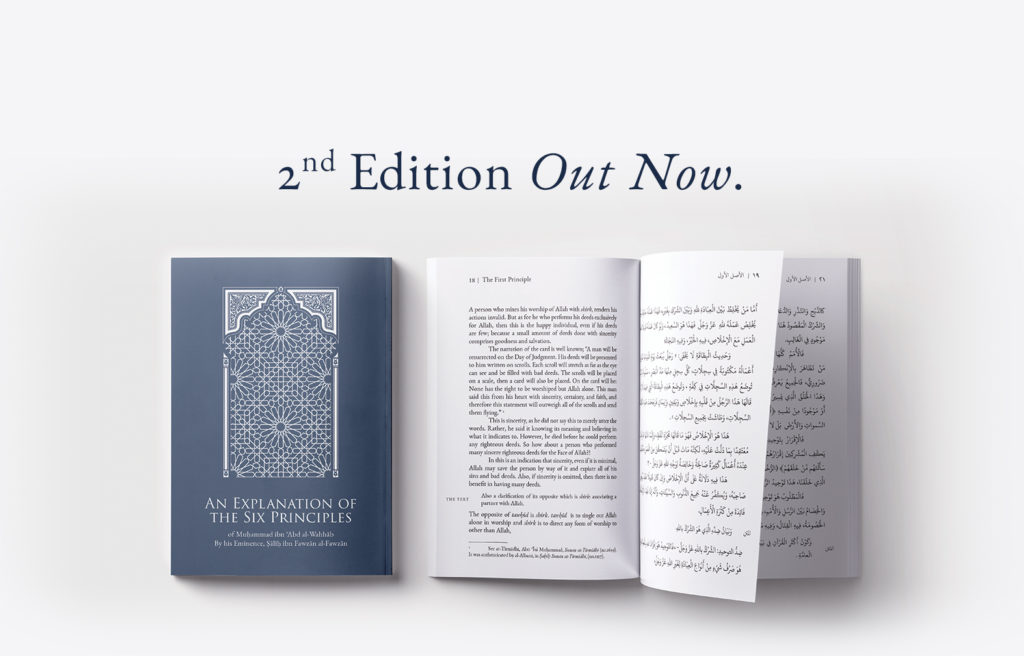
Here, then, is the second edition of this publication, which has undergone extensive revision. For the benefit of the student of knowledge and the learner of Arabic, a parallel translation has been introduced to assist with following and studying the text.
The translation has been kept as simple as possible to cater for a wider audience. Words without a satisfactory English equivalent have been transliterated, with explanations provided by the translator in footnotes marked [TN]. The speech of Ibn ʿAbd al-Wahhāb has been distinguished by a smaller, indented font adjacent to “the text”.
Coming December 2016.
References
Ibn ʿAbd al-Wahhāb, Muḥammad (d. 1206 AH/1792 CE), al-Qawāʿid al-Arbaʿ; al-Uṣūl as-Sittah (The Six Fundamental Principles), second edition; Kashf ash-Shubuhāt fī at-Tawḥīd; Kitāb at-Tawḥīd; and Masāʾil al-Jāhiliyyah allatī Khālafa fīhā Rasūl Allah Ahl al-Jāhiliyyah. Mentioned in the announcement; publication details were not supplied.
Muslim ibn al-Ḥajjāj (d. 261 AH/875 CE), Ṣaḥīḥ Muslim, no. 1631, on ongoing charity, beneficial knowledge and a righteous child’s prayers.